



More Than Just Monuments
Ancient structures are more than just a backdrop for our photos; they are silent witnesses to the world they were built in. Long before we had satellites and weather stations, the environment was leaving its signature on everything around it. Scientists
refer to this as “proxy data”—indirect evidence of past climate conditions preserved in natural archives. While we often think of ice cores and sediment layers, the historic buildings we cherish are also a crucial, and often overlooked, part of this global archive. From the materials chosen by builders to the wear and tear inflicted by centuries of weather, these sites passively recorded the climate, giving us a baseline against which we can measure today’s unprecedented changes.
Reading the Silent Record
So how exactly do scientists read these architectural archives? One of the most powerful techniques is dendrochronology, or tree-ring dating. The timber beams in an old fort or temple roof hold a precise record of the climate during the tree's life. Wide rings suggest years of good rainfall and favourable growing conditions, while narrow rings can indicate drought or cold spells. By cross-referencing these patterns with master chronologies, researchers can not only determine the exact year a tree was felled for construction, but also reconstruct past climate events with remarkable accuracy. Beyond wood, scientists can analyse the chemical composition of ancient mortar to understand past air quality or study the weathering patterns on stone to learn about historical rainfall and temperature fluctuations. Every element becomes a clue.
Stories from Stone and Wood
This architectural data tells compelling stories. For instance, research on historic buildings in China from 750 to 1750 AD revealed that the steepness of roofs changed over time. During periods of heavy snowfall, builders constructed steeper roofs to prevent collapse, while in warmer eras, roofs became flatter, likely to save on materials and labour. These design shifts, preserved for centuries, act as a tangible record of changing weather patterns. Similarly, ancient Roman villas with underfloor heating systems and Sumerian homes with wind-catching towers show how societies have always adapted their architecture to the prevailing climate. These structures are not just feats of engineering but a direct response to environmental conditions, providing a blueprint of past climate resilience.
An Unfolding Tragedy in India
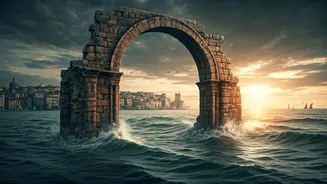
The tragic irony is that the very heritage sites holding these climate records are now under severe threat from modern climate change. In India, home to 43 UNESCO World Heritage Sites, the danger is acute. Coastal monuments like the Shore Temple in Tamil Nadu and the forts of Goa face the dual threat of rising sea levels and intense cyclones. Unusually heavy rainfall has caused damage to ancient structures, including the partial collapse of a wall at the 12th-century Sonar Fort in Jaisalmer. Meanwhile, increased humidity and air pollution are accelerating the degradation of delicate murals in the Ajanta Caves and causing discoloration on the marble of the Taj Mahal. In response, the Archaeological Survey of India (ASI) has begun installing automated weather stations at various monuments to monitor conditions and mitigate damage.
A Race Against Time
Globally, it is estimated that one in six cultural heritage sites is now threatened by climate change. From the eroding Moai statues of Rapa Nui (Easter Island) to the crumbling mud-brick mosques of Mali, our shared history is at risk. International bodies like ICOMOS and UNESCO have sounded the alarm, urging for cultural heritage to be integrated into global climate action plans. They argue that protecting these sites is not just about saving buildings, but preserving irreplaceable data. The challenge is immense, and experts acknowledge that hard choices will have to be made about what can be saved. We are in a race to document and learn from these climate archives before they are lost forever to the very phenomena they can help us understand.