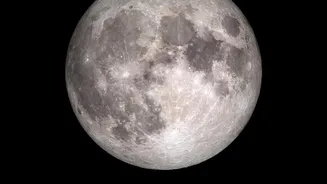






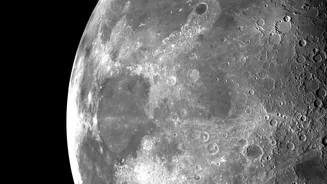
Ever been stopped in your tracks by a colossal Moon hanging just above the horizon? This stunning sight, the Moon illusion, isn't real—it's a trick of the mind. It has captivated and puzzled humanity for millennia, from ancient philosophers to today's
neuroscientists.
An Ancient Atmospheric Riddle
The mystery of the Moon illusion is as old as philosophy itself. Ancient Greek thinkers were among the first to formally document and theorize about this celestial puzzle. Around the 4th century BCE, Aristotle proposed that the illusion was a physical phenomenon. He suggested that Earth's atmosphere acts like a giant lens, magnifying the light from the Moon when it is near the horizon because we are looking through a thicker, denser layer of air. This idea, rooted in the observable world, held sway for centuries. Later, in the 2nd century CE, the astronomer Ptolemy revisited the problem. While he initially considered atmospheric refraction, he also began to suspect that the answer lay not in the sky, but within the observer. He theorized that it was an optical illusion related to our perception of distance, a revolutionary idea that hinted the solution was psychological, not physical.
A Leap Forward to the Mind's Eye
The most significant conceptual leap in understanding the Moon illusion came during the Islamic Golden Age. In the 11th century, the brilliant polymath Ibn al-Haytham (known in the West as Alhazen) fundamentally shifted the debate. Rejecting the long-held Greek theory that our eyes emit rays to see, he correctly argued that vision works because light enters the eye. This insight was crucial. He proposed that the Moon illusion was not caused by the atmosphere, but by the brain's interpretation of what the eye sees. Ibn al-Haytham argued that our brains perceive the sky not as a perfect hemisphere, but as a flattened dome. Because we are used to seeing objects like clouds and birds on the horizon as being very far away, our brain applies this same logic to the Moon. When the Moon is overhead in an empty sky, there are no intervening objects to give us a sense of scale.
The Apparent Distance Hypothesis
Ibn al-Haytham's work laid the foundation for what is now the leading explanation: the Apparent Distance Hypothesis. This theory posits that our brain judges an object's size based on both its size on our retina and its perceived distance. You can prove to yourself that the Moon's size on your retina never changes by holding a coin at arm's length—it will cover the Moon just the same on the horizon as it does high in the sky. Since the retinal image is constant, the brain is left to judge distance. When the Moon is near the horizon, it's surrounded by familiar depth cues—trees, buildings, and the texture of the landscape. Your brain interprets these cues to mean the Moon is extremely far away. To reconcile a 'far away' object having the same retinal size as a 'closer' overhead moon, your brain concludes the horizon Moon must be physically enormous.
It's All About the Context
Another powerful psychological explanation is the Ponzo illusion, first described by Mario Ponzo in 1912. Imagine two identical lines drawn on a pair of converging railway tracks. The line 'further away' up the tracks will look longer. The converging lines trick your brain into perceiving depth, so it scales up the more 'distant' object. The Moon illusion may work in a similar way. The landscape tapering toward the horizon provides those converging lines, telling your brain the Moon is far away and therefore must be larger. In contrast, the zenith Moon hangs in a vast, empty expanse, providing no context for scale. Without these reference points, our brain perceives it as closer and, consequently, smaller. This is why the illusion vanishes if you look at the horizon Moon through a paper tube, blocking out the surrounding environment.