




A Journey to an Ocean World
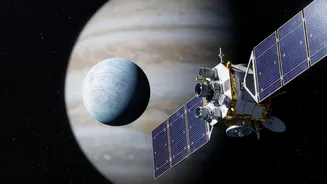
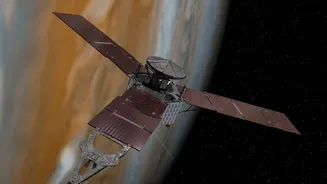
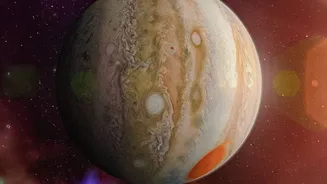
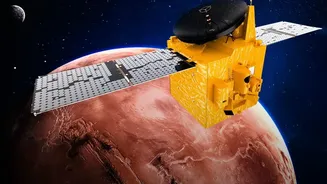
Launched in October 2024, the Europa Clipper spacecraft is undertaking a monumental 2.9-billion-kilometre journey to the Jupiter system. It is the largest interplanetary spacecraft ever built by NASA, with solar arrays that span the length of a basketball
court. The probe is not flying directly to Jupiter but is on a 5.5-year trajectory that includes gravity assists from Mars in 2025 and Earth in 2026 to build up enough speed. Upon its arrival in April 2030, Clipper will not orbit Europa directly due to Jupiter's intense radiation. Instead, it will enter a long, looping orbit around Jupiter and perform approximately 49 close flybys of Europa, dipping in to gather data before retreating to safety. This intricate dance will allow for a detailed survey of the moon over several years.
The Three Ingredients for Life
Europa Clipper isn't looking for life itself, but for the conditions that could support it, known as habitability. Scientists have identified three key ingredients necessary for life as we know it: liquid water, essential chemical elements, and a source of energy. Evidence strongly suggests Europa has a global saltwater ocean beneath its ice shell, containing about twice as much water as all of Earth's oceans combined. The necessary chemical building blocks, like carbon and other organic compounds, are believed to have been delivered by asteroids and comets over billions of years. The final piece is energy. Far from the sun, life on Europa couldn't rely on photosynthesis. Instead, energy could come from chemical reactions, potentially fueled by materials from the seafloor or from Jupiter's radiation interacting with the surface ice.
Peering Beneath the Ice
To investigate this hidden world, Clipper is equipped with a powerful suite of nine science instruments that will work together. A key objective is to confirm the ocean's existence and understand the ice shell above it. The Radar for Europa Assessment and Sounding: Ocean to Near-surface (REASON) instrument is designed to do just that. It functions like an ice-penetrating radar, sending out signals that can probe the ice shell to determine its thickness and search for the boundary where ice meets liquid water. This could also reveal any pockets of water that may be trapped within the shell itself. Working alongside it are a magnetometer (ECM) and a plasma instrument (PIMS) that will measure the magnetic field around Europa. A liquid, salty ocean would respond to Jupiter's magnetic field in a specific way, allowing scientists to measure the ocean's depth and salinity.
Sniffing for Chemical Clues
Understanding the chemistry of Europa is crucial to assessing its habitability. Since landing and drilling through the ice is not an option for this mission, Clipper will ingeniously sample the moon from space. Scientists suspect that plumes of water vapor may erupt from Europa's surface, similar to those on Saturn's moon Enceladus. The SUrface Dust Analyzer (SUDA) is designed to scoop up tiny particles ejected from the surface — either from plumes or meteorite impacts — and analyze their chemical makeup. This could provide direct clues about the composition and salinity of the subsurface ocean. Meanwhile, the MAss Spectrometer for Planetary EXploration/Europa (MASPEX) will analyze gases in the moon’s faint atmosphere and any potential plumes it flies through, searching for the chemical building blocks of life.
Mapping a Dynamic World
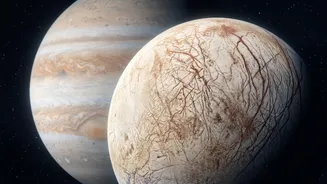
The spacecraft will also create the most detailed maps of Europa ever seen, helping scientists understand its geology and identify areas of interest. The Europa Imaging System (EIS), a pair of powerful cameras, will capture high-resolution, color images of the surface. These images will help identify geologic activity, such as cracks and ridges, that could indicate the movement of the ice shell over the ocean. Another instrument, the Mapping Imaging Spectrometer for Europa (MISE), will analyze the surface composition by looking at the infrared light it reflects, creating maps of ices, salts, and organic materials. Finally, the Europa Thermal Emission Imaging System (E-THEMIS) will act as a heat detector, scanning for thermal anomalies that could indicate warmer ice or recent eruptions of water from below the surface.