


A New Home on the Moon
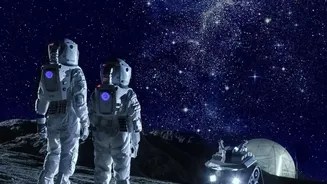
NASA is moving beyond the "flags and footprints" era of lunar exploration. The agency's vision is the Artemis Base Camp, a permanent outpost near the Moon's south pole designed to support astronauts for long-duration stays. This won't be a simple tent.
The plan includes a stationary home called the Foundation Surface Habitat, which could house up to four astronauts for a month or more at a time. Alongside this main habitat, astronauts will use a pressurized rover—essentially a high-tech camper van—for long-range exploration trips lasting weeks, and a smaller, unpressurized Lunar Terrain Vehicle for local transport. More than 20 robotic missions are planned through 2029 to deliver scientific instruments, test technologies, and lay the groundwork for this ambitious settlement.
Location, Location, Location: Why the South Pole?
The choice of the lunar south pole is no accident; it is a region of strategic importance. This area offers the best of both worlds in the harsh lunar environment. The rims of craters like the Shackleton Crater receive near-constant sunlight, providing an invaluable source of solar power for the base. Just a few kilometers away, deep inside these same craters, are Permanently Shadowed Regions (PSRs). These areas have not seen sunlight in billions of years, making them incredibly cold and creating perfect 'cold traps' for preserving a precious resource: water ice. This combination of near-endless energy and frozen water makes the south pole the most logical place to set up a sustainable human presence.
The Ultimate Resource: Water Is Everything
The presence of water ice transforms the entire equation for lunar living. The concept, known as In-Situ Resource Utilization (ISRU), is simple: live off the land. Mining this ice provides the essential building blocks for survival and exploration. First, it can be melted and purified into drinking water. Second, through a process called electrolysis, the water molecules (H₂O) can be split into breathable oxygen for the habitat and hydrogen. That same hydrogen and oxygen, when cryogenically cooled into liquids, become a powerful rocket propellant. This means the Moon could one day become a refueling station for missions deeper into space, dramatically cutting the cost and complexity of sending everything from Earth.
How to Mine the Moon
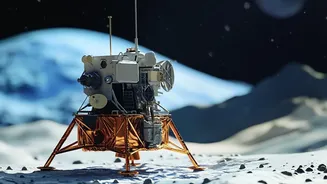
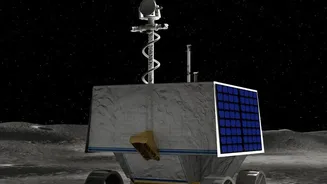
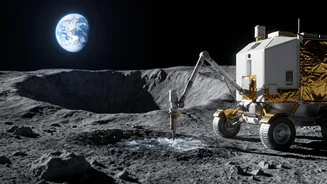
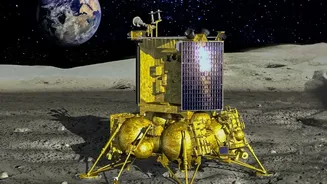
Extracting water from the frozen, abrasive lunar soil, or regolith, is a significant engineering challenge. The process begins with robotic prospectors, like those being sent by NASA's commercial partners, to map the ice deposits and determine their concentration and depth. Future mining operations will likely involve rovers equipped with drills and heating elements. These machines would drill into the icy regolith, heat it to release the water as vapor, and then capture that vapor before it escapes into the vacuum of space. The captured vapor would then be condensed back into liquid water for processing. NASA and its partners are currently testing various technologies, including drills and specialized spectrometers, on a series of missions to perfect these techniques before astronauts arrive.
A Stepping Stone to Mars
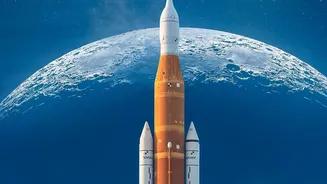
The Artemis Base Camp is more than just a destination; it's a critical proving ground for humanity's future in deep space. The challenges of building and operating a permanent outpost on the Moon—from dealing with extreme temperatures and radiation to utilizing local resources—are the same challenges we will face on Mars. Learning to live and work sustainably on our nearest celestial neighbor will provide the invaluable experience and technological validation needed to plan a human mission to the Red Planet. In this way, the lunar habitat is not the final goal, but a vital step in transforming humanity into a multi-planetary species, turning the Moon into a gateway to the rest of the solar system.