




A Telescope Unlike Any Other
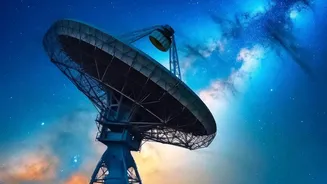
Deep in the radio-quiet hills of British Columbia sits one of the strangest-looking telescopes on Earth. The Canadian Hydrogen Intensity Mapping Experiment, or CHIME, isn't a familiar dish. Instead, it looks like four giant metal half-pipes for cosmic
snowboarding. With no moving parts, CHIME surveys the entire northern sky every single day as the Earth rotates. Its unique design allows it to collect faint radio waves from deep history, specifically the signature glow emitted by hydrogen, the most abundant element in the universe. This makes it a powerful and cost-effective tool for mapping the cosmos on an unprecedented scale.
Listening for a Cosmic Echo
CHIME’s primary mission is to listen for the echo of sound waves that rippled through the hot, dense plasma of the very early universe, just after the Big Bang. These waves, known as Baryon Acoustic Oscillations (BAO), left behind vast, spherical shells of matter. The size of these shells is known to cosmologists, making them a 'standard ruler' to measure the vast distances across space and time. By charting the distribution of hydrogen gas, which follows the pattern of these ancient shells, CHIME can create a massive 3D map of the universe at different points in its history. This map shows how quickly the universe was expanding billions of years ago.
The Hunt for Dark Energy
So where does dark energy fit in? In the late 1990s, astronomers discovered that the universe's expansion isn't slowing down due to gravity, as expected; it's speeding up. 'Dark energy' is the name given to the mysterious pressure causing this acceleration. It’s believed to make up nearly 70% of the universe, but we know almost nothing about what it is. By using the BAO standard ruler to measure the expansion rate at different epochs, scientists can test theories about how dark energy behaves. The era CHIME is studying—when the universe was between 2.5 and 7 billion years old—is a critical period when dark energy began to dominate the cosmos.
A Breakthrough, Not a Solution
The recent excitement surrounds CHIME's first major success: it has made a standalone detection of the faint hydrogen glow from when the universe was about five billion years old. This is a landmark achievement because it proves the 'intensity mapping' technique works without needing to cross-reference with other, more expensive galaxy surveys. However, while this proves the method, the data from this initial finding is not yet precise enough to solve the dark energy riddle. It confirms the map can be made, but doesn't yet provide the fine details needed to distinguish between competing theories about dark energy's nature—whether it's constant or changes over time.
Why This Finding Still Matters
To say this finding doesn't explain dark energy is to miss the point of how science works. This result is not a failure but a crucial proof of concept. It is the scientific equivalent of showing you can build a new type of ship and that it floats. The next step is to use it for the long voyage. CHIME has now collected years of data that can be analyzed with this proven technique. By pushing this method to look even further back in time, researchers will be able to map the universe's expansion with increasing precision. This finding has successfully opened a new, powerful, and cost-effective window to probe the universe's greatest mystery. The answer to dark energy may not be here today, but CHIME has confirmed it is on the right path to finding it.