


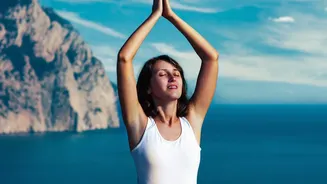
More Than Just a Pose
Long before yoga was associated with flexible postures and stylish mats, it was a comprehensive philosophy for living. The word 'yoga' itself comes from the Sanskrit root 'yuj', meaning to unite or join, signifying the union of individual consciousness
with a universal one. The foundational text of classical yoga, Patanjali's Yoga Sutras, compiled over two millennia ago, barely focuses on physical postures. Instead, its primary aim is to guide the practitioner toward stilling the turbulent fluctuations of the mind. This ancient wisdom posits that true peace is not something to be acquired, but a state to be uncovered by removing the obstacles of a distracted, restless mind. It’s a science of self-realization, with physical health being just one byproduct of a much deeper inner journey.
The Journey to the West
Yoga's journey from an Indian spiritual tradition to a global movement was championed by pioneering teachers who acted as cultural bridges. The first major introduction came in 1893, when Swami Vivekananda addressed the Parliament of the World's Religions in Chicago. He spoke of yoga not as a series of exercises, but as a science of the mind and a universal path to spiritual experience, captivating a Western audience hungry for new ideas. This opened the door for other influential gurus in the 20th century. Teachers like B.K.S. Iyengar and K. Pattabhi Jois systemised the physical practices (asanas), making them more accessible to a global audience and laying the groundwork for modern postural yoga. Iyengar, in particular, gained worldwide fame for his focus on alignment and therapeutic benefits, further cementing yoga's place in the West.
From Ancient Sutras to Modern Self-Care
So, how did a philosophy focused on spiritual liberation become synonymous with stress relief and mental wellness? The answer lies in the timeless relevance of its core principles. The ancient sutras address universal human struggles like distraction, anxiety, and the desire for peace, which resonate deeply in our fast-paced modern world. Practices like 'pranayama' (conscious breathing) and 'dhyana' (meditation), central to classical yoga, are now validated by modern science for their ability to regulate the nervous system and improve mental health. The philosophy that the body and mind are interconnected is a cornerstone of the modern wellness movement. Yoga provides a practical toolkit to manage the pressures of contemporary life, making ancient wisdom directly applicable to everyday problems.
Asana: The Universal Entry Point
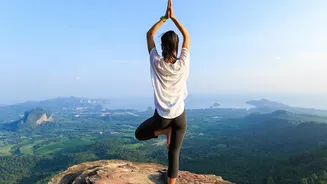
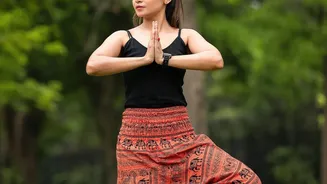
While the philosophy is the soul of yoga, the physical practice of asana became its most visible and accessible form. For many, the journey into yoga begins on the mat, through movement. This physical entry point is a key reason for its global appeal. Asanas offer tangible benefits like improved flexibility, strength, and balance, which are universally desired. However, the true transformation often happens subtly. The discipline of holding a challenging pose teaches mental resilience and focus. The practice of linking breath with movement, a hallmark of styles like Vinyasa, becomes a form of moving meditation. In this way, the physical practice serves as a gateway to the deeper, mental and spiritual benefits that ancient yogis sought, making the profound accessible through the practical.
The 'Yoga Lifestyle' Today
Today, for millions, yoga is far more than a weekly class; it has evolved into a complete lifestyle. This modern interpretation draws heavily from yoga's ethical foundations, even if practitioners don't explicitly study them. The pursuit of balance, mindfulness in daily activities, a sense of community, and a conscious approach to consumption all echo the ancient principles. It has become a holistic system for living with greater awareness and purpose. This transformation from a niche spiritual practice to a global lifestyle choice was officially recognized in 2014, when the United Nations declared June 21st as the International Day of Yoga, honouring its universal appeal and Indian heritage.