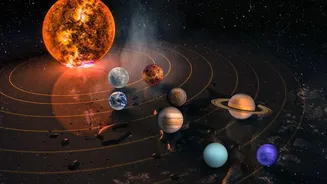








Saturn Takes Centre Stage
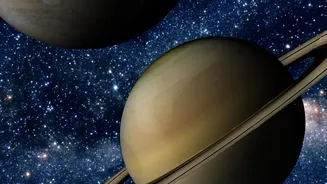
The main event this month features the solar system’s famously ringed planet. On October 4th, Saturn reaches opposition, an annual celestial alignment where Earth passes directly between the Sun and Saturn. This event makes it the best time of year to view
the planet. From our perspective, Saturn will rise in the east around sunset, travel across the night sky, and set in the west around sunrise, making it visible all night long. It will also be at its closest and brightest, shining with a steady, yellowish light. While you won’t see its rings with the naked eye, Saturn will be a brilliantly distinct point of light. To distinguish it from a star, remember that planets tend to shine with a more stable light, whereas stars appear to twinkle. Even a basic pair of binoculars might reveal that it is not just a point but a tiny disc, hinting at its grander shape. For those in India, the planet will be well-placed for viewing from early evening onwards.
Jupiter, The Morning Jewel
Not to be outdone, the king of planets, Jupiter, will be a dazzling sight in the pre-dawn sky throughout October. While Saturn commands the evening, Jupiter rules the hours before sunrise. Look towards the east in the early morning to find an unmistakably brilliant, star-like object that outshines everything else around it. Its intense, unwavering glow makes it easy to identify. For a special treat, look up on the morning of October 6th. On this date, a slender crescent Moon will appear very close to Jupiter, creating a beautiful pairing in the sky that is perfect for early risers. With a good pair of binoculars, you may even be able to spot up to four of Jupiter’s largest moons, which look like tiny pinpricks of light huddled close to the planet itself. These are the same moons Galileo Galilei first observed centuries ago, changing our understanding of the cosmos.
Catching The Orionid Meteors
October also brings one of the year’s most reliable and beloved meteor showers: the Orionids. Active from early October to early November, this shower is caused by Earth passing through the dusty debris trail left behind by the famous Halley’s Comet. The shower is set to reach its peak on the night of October 21st and into the early morning of October 22nd. Under perfect conditions, you might see between 15 and 25 meteors per hour. However, there is a challenge this year. A bright waxing gibbous Moon will be high in the sky for most of the evening, its light threatening to wash out many of the fainter meteors. But don’t be discouraged. There is a perfect window for viewing. The Moon is expected to set around 3 a.m. local time on the peak mornings. This leaves the hours between moonset and dawn completely dark, offering the best opportunity to catch the show. The meteors will appear to radiate from the constellation of Orion but can be seen streaking across any part of the sky.
Your Guide to a Perfect Night of Stargazing
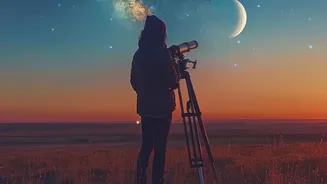
To make the most of these celestial events, a little preparation goes a long way. The single most important factor is finding a dark location away from the glare of city lights. Even a short drive out of town can make a huge difference. Once you’ve found your spot, give your eyes at least 20 to 30 minutes to fully adapt to the darkness; you will be amazed at how many more stars become visible. Avoid looking at your bright phone screen, as it will instantly reset your night vision. Comfort is key for enjoying the sky. Bring a blanket to lie on or a comfortable chair, as you will be looking up for a while. October nights can get chilly, even in warmer parts of India, so layering up with a jacket or shawl is a good idea. You don’t need a telescope to enjoy the planets or a meteor shower, but a pair of binoculars can certainly enhance the view of Saturn and Jupiter. Finally, check the weather forecast before you head out. Clear skies are a stargazer's best friend.