





The Pollutant Problem: PM2.5 and VOCs
Before we compare, let's understand the enemy. Indoor air quality is often compromised by two main culprits. First, there's PM2.5—fine particulate matter smaller than 2.5 micrometres. These tiny particles come from vehicle exhaust, industrial emissions,
and smoke, and can easily infiltrate our homes from the outside. They are a major health concern as they can penetrate deep into our lungs and even enter the bloodstream. Second, we have Volatile Organic Compounds (VOCs). These are gases emitted from everyday items like paint, furniture, cleaning supplies, and air fresheners. Common VOCs include formaldehyde and benzene. Improving indoor air means tackling both particles and gases.
The Main Battle: Removing PM2.5
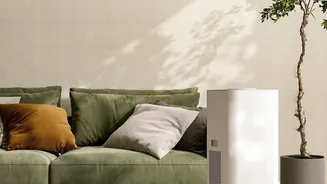
When it comes to the dangerous threat of PM2.5, the winner is clear and undisputed: the air purifier. Air purifiers equipped with High-Efficiency Particulate Air (HEPA) filters are specifically engineered to capture these microscopic particles. A quality HEPA filter can remove up to 99.97% of airborne particles as small as 0.3 microns, which includes PM2.5, dust, pollen, and pet dander. Plants, on the other hand, have a negligible effect on PM2.5. While some dust may settle on their leaves, they do not actively filter fine particulate matter from the air. In studies comparing the two directly under polluted conditions, air purifiers cleaned the air of PM2.5 significantly faster than plants. For anyone concerned about outdoor pollution getting inside, a HEPA purifier is the only effective solution.
The Myth of the Jungle: Plants and VOCs
This is where the debate gets interesting. The idea that houseplants are great air purifiers stems largely from a 1989 NASA study which found that plants could absorb VOCs in a small, sealed chamber. This is true—plants can absorb some VOCs through their leaves and the microorganisms in their soil. However, the real world is not a sealed chamber. Subsequent research has shown that the effect in a typical, ventilated room is incredibly small. To match the air-cleaning power of a single air purifier, you would need an impractical number of plants—some studies estimate between 10 and 1,000 plants per square metre of floor space. So while your snake plant or peace lily might be absorbing a tiny amount of formaldehyde, it can't compete with the constant off-gassing from your furniture or the efficiency of an active filtration system.
Air Purifiers and VOCs: The Carbon Factor
While HEPA filters are for particles, they do not remove gaseous VOCs. For that, you need an air purifier with a substantial activated carbon filter. Activated carbon works through adsorption, trapping gas molecules on its surface. The effectiveness depends on the amount and quality of the carbon. Many basic air purifiers have only a light dusting of carbon, which is quickly saturated. For serious VOC removal—for instance, in a newly painted room—you need a purifier with several pounds of activated carbon. These specialized units are highly effective at reducing chemical fumes and odours, something plants can only do at a minuscule rate.
Cost, Care, and Co-Benefits
An effective air purifier is a significant upfront investment, with ongoing costs for electricity and filter replacements every 6 to 12 months. Plants are cheaper initially, but require regular watering, light, and care. Of course, plants offer benefits that machines don't. They are aesthetically pleasing, can boost mood, reduce stress, and add a touch of nature to our indoor lives. Some studies even suggest they can slightly increase humidity, which can be beneficial in dry climates. An air purifier is a functional appliance; a plant is a living piece of decor.