




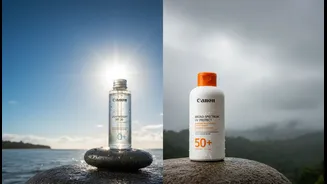



The Great Monsoon Myth
It’s a belief many in India share: if you can't see the sun, it can't harm your skin. Unfortunately, this is a dangerous misconception. The cool, grey, and rainy days of the monsoon lull us into a false sense of security. Dermatologists across the country
report treating what they call “monsoon skin damage” that surfaces months later. While clouds block visible light and some heat, they are not a shield against damaging ultraviolet (UV) radiation. In fact, up to 80% of the sun's UV rays can pass through cloud cover, meaning your skin is still exposed even when it’s pouring outside.
Understanding the Invisible Threat: UVA vs. UVB
To grasp why cloudy days are risky, it’s essential to know the enemy. The sun emits two main types of UV rays that reach us: UVA and UVB. UVB rays are shorter and are the primary cause of immediate skin damage like sunburn. Clouds do block a portion of these. However, UVA rays have a longer wavelength, allowing them to penetrate clouds, glass, and the skin more deeply. They are the main culprit behind premature ageing—wrinkles, fine lines, and sagging—and contribute significantly to hyperpigmentation. UVA rays are present with consistent intensity during all daylight hours, year-round, making them a constant threat, rain or shine.
Why Clouds and Rain Aren’t Enough
Not only do clouds let most UVA rays through, but the monsoon environment can sometimes increase your UV exposure. Wet roads, puddles, and buildings reflect UV rays, scattering them and causing them to hit your skin from multiple angles. This means that even if you're under an umbrella, reflected radiation can still cause damage. Furthermore, in conditions with broken clouds, UV levels can sometimes be even higher than on a completely clear day, a phenomenon known as the 'broken cloud effect,' where rays are reflected and amplified.
Your Monsoon Armour: Choosing the Right Sunscreen
The key to monsoon skin protection is choosing a sunscreen you will actually want to wear in high humidity. For the Indian climate, experts recommend looking for a few key features. First, it must be “broad-spectrum,” meaning it protects against both UVA and UVB rays. Look for an SPF of 30 or higher; SPF 50 is often recommended. Equally important is the PA rating (often seen as PA+, PA++, etc.), which indicates the level of UVA protection. Given the humidity and rain, a water-resistant formula is non-negotiable to prevent it from sweating or washing off immediately. Lightweight, non-greasy, gel-based, or fluid formulations are generally more comfortable for oily and combination skin types prevalent in India, and are less likely to clog pores.
Making it a Habit That Sticks
The best sunscreen is one that is used consistently. Dermatologists advise applying it as the last step of your morning skincare routine, about 15-20 minutes before heading out. A common mistake is not using enough. For the face and neck, you should use approximately one teaspoon. Reapplication is just as crucial. The high humidity and sweat during the monsoon mean your sunscreen can wear off faster. It’s important to reapply every two to three hours, especially if you’ve been outdoors, sweating, or caught in a downpour. Think of it not as a seasonal task, but a daily ritual for your skin's long-term health—just like brushing your teeth.