





Seeing the Invisible Universe
Unlike the Hubble Space Telescope, which primarily sees the universe in visible light, Chandra is designed to detect X-rays. These are a high-energy form of light completely invisible to our eyes and mostly blocked by Earth's atmosphere. X-rays are emitted
by the most extreme environments in the cosmos: exploding stars, supermassive black holes, and clouds of gas heated to millions of degrees. To capture these signals, Chandra orbits high above our planet, using a special set of four nested mirrors to gently guide the incoming X-ray photons to its detectors. Because X-rays are so energetic, they can't be focused like visible light; instead, they are reflected at very shallow, grazing angles, like a stone skipping across a pond. The result isn't a photograph in the traditional sense, but a stream of raw data—a list of positions, energies, and arrival times of individual X-ray photons.
The Art and Science of False Colour
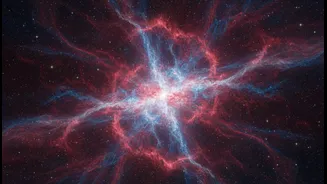
So, if Chandra doesn't take photos, where do the stunning, colourful images come from? The process is called false-colour imaging, and it’s a crucial tool for making invisible data understandable. Since X-rays have no colour we can perceive, scientists assign colours to different ranges of X-ray energies. Typically, lower-energy X-rays are assigned red, medium-energy ones green, and higher-energy ones blue. When these are combined, a multicoloured image emerges. The colours aren't arbitrary; they are chosen to highlight specific scientific features. For example, in the remnant of an exploded star, one colour might represent silicon, another iron, revealing the chemical makeup of the debris cloud. This allows scientists to distinguish between different materials and processes that would be lost in a simple black-and-white image.
Data That Tells a Story
The 'drama' in Chandra's images is the visual representation of cosmic events of incredible power. These images are more than just aesthetically pleasing; they are tools for discovery. For example, Chandra’s observations provided direct proof of dark matter's existence by imaging the collision of galaxy clusters. The false-colour images showed that the hot, X-ray emitting gas (normal matter) was separated from the gravitational mass (dark matter). Chandra has also given us unprecedented views of the chaotic region around the supermassive black hole at the center of our Milky Way galaxy, revealing hundreds of smaller black holes and neutron stars. It has mapped the shockwaves from supernovas, watched young stars unleash violent flares, and discovered entirely new types of black holes. Each colour-coded feature tells a part of the story of how these objects form, evolve, and impact the universe around them.
A Multi-Telescope Symphony
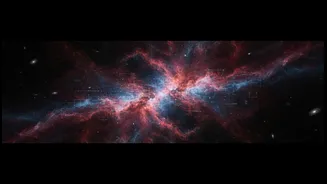
Many of the most famous space images are actually composites, combining data from several different telescopes to create a more complete picture. Chandra’s X-ray data is often layered with infrared data from the James Webb Space Telescope and visible light data from Hubble. In these multi-wavelength images, each telescope contributes a different piece of the puzzle. Hubble might show the elegant spiral arms of a galaxy, Webb might reveal the cool dust lanes where stars are born, and Chandra adds the high-energy glow of a central black hole or the remnants of exploded stars. Recently, NASA released a series of images celebrating the upcoming 250th anniversary of the United States, combining data from multiple telescopes to create patriotic 'red, white, and blue' portraits of cosmic objects like the Cassiopeia A supernova remnant and the NGC 3603 nebula. This collaborative approach turns raw data from across the electromagnetic spectrum into a single, cohesive, and scientifically rich narrative.