



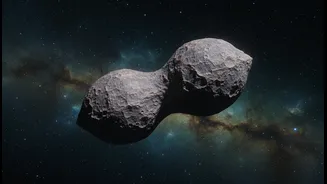


What is the Torifune Encounter?
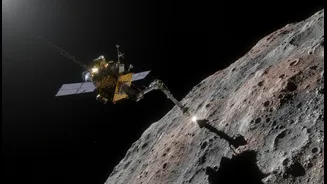
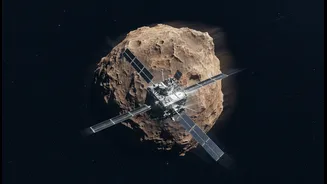
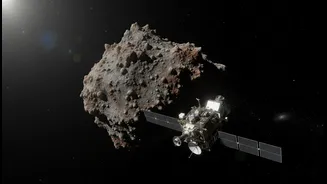
The Japan Aerospace Exploration Agency (JAXA) confirmed its Hayabusa2 probe successfully completed a close flyby of a near-Earth asteroid named Torifune on July 5, 2026. This wasn't a landing; it was a high-speed pass, with the spacecraft whizzing by at roughly
5 kilometers per second. The encounter is part of Hayabusa2's extended mission. Its primary mission was famously completed in 2020 when it returned precious samples from the asteroid Ryugu to Earth. With plenty of fuel left, JAXA sent the veteran probe on a new journey, with the Torifune flyby being a key milestone before it attempts to visit a much smaller asteroid, 1998 KY26, in 2031.
First Images and Initial Data
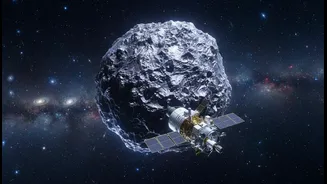
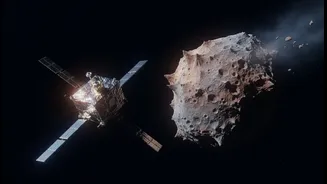
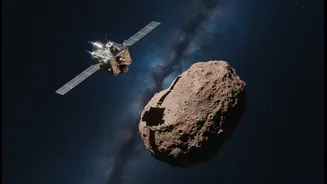
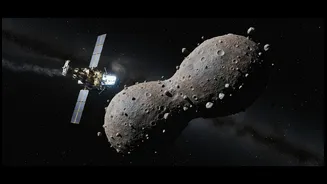
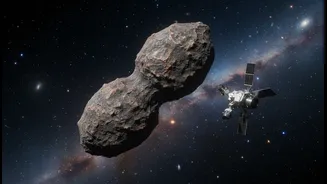
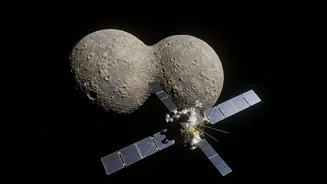
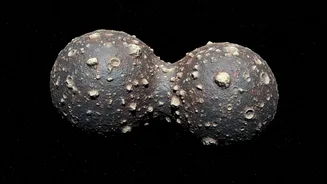
Immediately following the flyby, JAXA released stunning initial images of Torifune captured by Hayabusa2's optical and thermal cameras. The pictures revealed a two-lobed, or 'double-headed,' asteroid about 450 meters in diameter. This confirmed what ground-based telescopes had long suggested but could never see in detail. However, JAXA was quick to note that only a portion of the data gathered during the close approach has been transmitted back to Earth. The observations were conducted only up to the point of closest approach, not after, due to the technical challenges of the high-speed maneuver. The full dataset will be downloaded in future communication sessions.
The Need for Verification
The headline-grabbing images are just the beginning. The real scientific work lies in verifying and analyzing the terabytes of telemetry and instrument data now trickling back. Every piece of information, from the spacecraft's precise trajectory to the asteroid's temperature and composition, must be cross-referenced and validated. Space agencies like JAXA and NASA have rigorous protocols for this. They use multiple instruments to observe the same phenomena, allowing scientists to check one data stream against another. Analytical models are used to compare expected readings with what was actually observed, flagging any anomalies or inconsistencies that require deeper investigation. This process is slow and methodical by design. The goal is to separate definitive facts from instrumental noise or preliminary interpretations.
What Are Scientists Looking For?
The 'decisions' mentioned in the headline relate to both the future of the Hayabusa2 mission and the broader field of planetary defense. A primary goal of the Torifune flyby was to test high-precision guidance techniques for maneuvering a spacecraft close to a small, dark object at high speed. This was technically challenging, as the asteroid's exact location wasn't confirmed until days before the encounter. The skills honed here are crucial for future missions, including those designed to deflect a potentially hazardous asteroid. Scientists will now analyze the data to understand Torifune's physical properties: its exact shape, mass, rotation, and what its surface is made of. This information helps build a better 'zoo' of asteroids, providing crucial ground truth for planetary defense models that currently rely on less detailed, ground-based observations.
Why Patience Is a Virtue in Space
In an age of instant updates, the deliberate pace of scientific verification can feel slow. But the stakes are incredibly high. A misinterpretation of data could lead to flawed conclusions about the nature of asteroids or incorrect assessments of a future threat. Furthermore, the spacecraft's health and future capabilities need to be assessed. Did the close pass expose it to more dust than expected? Are all systems performing as they should? Before JAXA mission planners can make firm decisions about Hayabusa2's approach to its final target in 2031, they need a complete and verified picture of what happened at Torifune. The process involves independent teams analyzing data, peer review, and a culture that prioritizes accuracy over speed.