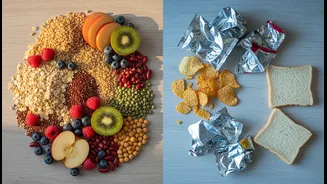








Beyond the 'Baked' Health Halo
The term 'baked' often comes with a 'health halo,' making us feel good about our choice. While baked chips do contain less fat and fewer calories than their fried counterparts, they are still ultra-processed foods. This means they are industrially manufactured
products, often high in refined carbohydrates, sodium, and additives, with little of the original food structure left. To compensate for the flavour lost from frying, manufacturers frequently add more sodium or even sugar, which can work against your health goals. They are designed to be 'hyper-palatable', making it easy to eat far more than you intended without feeling full.
The Power of Nutrient Density
Let's compare a handful of baked chips to an apple with a tablespoon of almond butter. The whole food snack provides a wealth of vitamins, minerals, antioxidants, healthy fats, and, crucially, dietary fibre. Baked chips, on the other hand, deliver 'empty calories' — energy without significant nutritional benefit. Whole foods are naturally nutrient-dense, meaning they pack more health-promoting compounds into every bite. This nutritional quality supports your body’s overall function, providing the tools it needs to operate efficiently, which is a cornerstone of a successful fat-loss journey.
Winning the Fullness Game
One of the biggest hurdles in fat loss is managing hunger. This is where whole foods have a massive advantage. The combination of fibre, protein, and water content in foods like vegetables, fruits, and legumes is highly satiating. These components fill you up, slow down digestion, and send signals to your brain that you are full, helping you naturally reduce your overall calorie intake. Studies have shown that people eating a diet of whole foods can feel more satisfied while consuming fewer calories than those on an ultra-processed diet. Baked chips lack the fibre and protein needed to trigger these powerful satiety signals, which is why it’s so easy to finish a whole bag and still feel hungry.
Your Metabolism on Whole Foods
Your body uses energy to digest food, a process known as the Thermic Effect of Food (TEF). Interestingly, whole foods require more energy to break down than processed foods. The complex structure of unprocessed ingredients, especially protein and fibre, forces your digestive system to work harder. Research has found that the energy expenditure to digest a whole-food meal can be nearly double that of a processed meal with the same calorie and macronutrient profile. While this metabolic boost from a single meal isn't huge, making consistent whole-food choices adds up, contributing to a slight but meaningful increase in your daily calorie burn over time.
Escaping the Blood Sugar Rollercoaster
The refined carbohydrates in baked chips are digested very quickly, causing a rapid spike in your blood sugar. In response, your body releases a surge of insulin, a hormone that helps shuttle sugar into your cells but also signals your body to store fat. This is often followed by a 'crash', leaving you feeling tired and craving more fast-acting carbs, creating a vicious cycle. In contrast, the fibre in whole foods slows the absorption of sugar, leading to a much gentler, more stable rise in blood glucose. This steady energy release helps prevent insulin spikes, keeping your body in a state that is more conducive to burning, rather than storing, fat.