







A Marathon Unlike Any Other
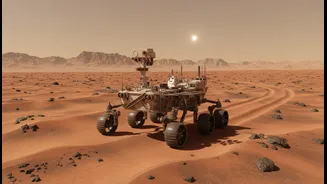
On June 14, 2026, after five years and four months on the Red Planet, the Perseverance rover's odometer ticked over to 26.2 miles, or 42.195 kilometres. This isn't just a victory lap; it's a monumental achievement in planetary exploration. A marathon
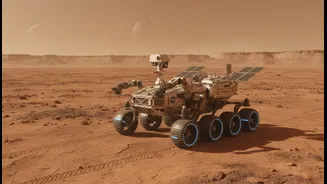
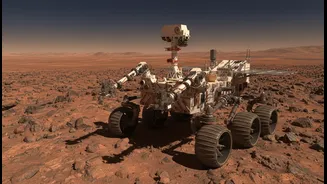
on Mars is far more challenging than one on Earth. The rover didn't sprint; it crawled, paused, drilled, and analyzed, all while navigating treacherous terrain with a significant time delay back to its mission controllers on Earth. Perseverance accomplished this feat in less than half the time it took the previous record-holder, the Opportunity rover, showcasing a significant leap in robotic navigation technology. Its advanced AutoNav system allows it to 'think while driving,' autonomously mapping its path and avoiding hazards, which has been crucial to its impressive pace.
The Scenic Route Through an Ancient Lakebed
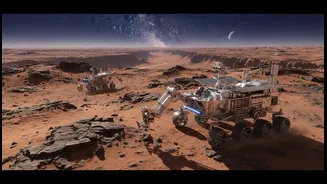
Perseverance's journey has been a carefully planned exploration of Jezero Crater, a 45-kilometre-wide basin that scientists believe was once a sprawling lake fed by a river delta billions of years ago. Landing in February 2021, the rover has spent years methodically traversing this ancient landscape, from the crater floor to the delta's sedimentary layers and up onto the crater rim. This location was chosen specifically because the fine-grained sediments deposited by water are excellent at preserving potential biosignatures—the chemical fingerprints of past life. Images from orbit, captured by the Mars Reconnaissance Orbiter, show the rover's winding tracks across the rusty terrain, a visible testament to its long and scientifically rich journey.
A Trail of Groundbreaking Discoveries
The marathon distance is impressive, but the scientific discoveries made along the way are the true prize. Perseverance's suite of advanced instruments has transformed our understanding of Jezero Crater. The rover confirmed that the crater floor is made of igneous, volcanic rock that interacted with water, a surprise to many scientists. It has studied ancient beach deposits and found evidence of sustained water activity, extending the potential window for habitability on Mars. Critically, its SHERLOC instrument detected a variety of organic molecules—the building blocks of life as we know it—in the Martian rocks. While these are not definitive proof of life, they are the strongest signals yet that the ingredients for life were present in this once-watery environment.
Collecting Postcards for a Future Delivery
One of Perseverance's primary objectives is to collect and cache samples of Martian rock and soil for a future mission to bring back to Earth. The rover is equipped to drill rock cores and seal them in pristine metal tubes. To date, it has gathered a diverse collection of samples that represent the geological history of Jezero Crater. These samples, containing everything from volcanic rock to fine-grained mudstone, are humanity's best hope for one day studying pristine Martian material in advanced laboratories on Earth. The marathon milestone was reached just as NASA is finalizing plans for the complex Mars Sample Return mission, which aims to retrieve these precious capsules.