


A Sugar Between the Stars
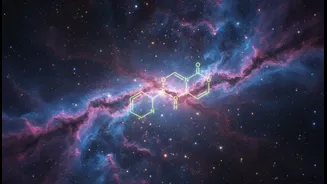
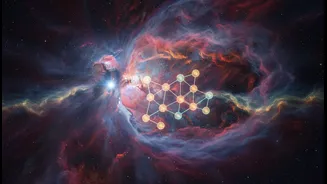
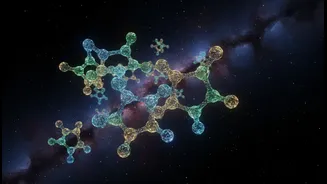
In a breakthrough for astrochemistry, scientists have detected erythrulose, a four-carbon sugar, in a molecular cloud near the center of our Milky Way galaxy. This isn't the sugar you put in your tea, but a vital prebiotic molecule. While simpler organic
molecules have been found in space before, this marks the first confirmed detection of a true sugar in the interstellar medium, the diffuse mixture of gas and dust from which stars and planets are born. Found in a massive cloud named G+0.693-0.027, the discovery was made by an international team using the Yebes 40-m and IRAM 30-m radio telescopes in Spain. By analyzing the faint radio signals emitted by molecules, they matched the distinct 'fingerprint' of erythrulose, a compound also found naturally in red raspberries.
The Ladder to Life
So, why is finding a specific sugar 26,000 light-years away so important? It has to do with a popular theory for the origin of life known as the 'RNA World' hypothesis. This theory suggests that before DNA, life was based on RNA (ribonucleic acid), a simpler molecule that can both store genetic information and act as an enzyme to drive chemical reactions. The backbone of RNA is made of a five-carbon sugar called ribose. Scientists have long wondered how ribose could have formed on early Earth, as lab experiments show it's difficult to create under primitive conditions. The discovery of erythrulose provides a compelling answer. It is considered a key stepping stone; in water, erythrulose can be converted into other sugars, including threose, a possible evolutionary predecessor to RNA. This suggests a plausible pathway from simple interstellar chemistry to the building blocks of genetics.
A Cosmic Delivery Service
The existence of erythrulose in a pre-stellar cloud shows that the chemical precursors for life can form long before planets even exist. This supports the idea that Earth may have gotten a head start on life. For years, scientists have found sugars and other organic compounds in meteorites and asteroid samples, such as those returned from the asteroid Bennu. This suggested that these vital ingredients were delivered to our young planet via comets and asteroids billions of years ago, a period known as the Late Heavy Bombardment. The detection of erythrulose in the interstellar medium is the missing link, confirming that such sugars are indeed available in the raw material from which these comets and asteroids form. It's evidence that the universe is seeded with the fundamental components needed for biology to begin.
Challenging Old Theories
The discovery also challenges previous ideas about how complex molecules form in space. Scientists were surprised to find that erythrulose was significantly more abundant—at least eight times more—than simpler three-carbon sugars in the same cloud. The prevailing view was that molecules grow sequentially, with smaller molecules gradually adding one carbon atom at a time. The abundance of this larger four-carbon sugar suggests that more complex formation pathways might be at play, possibly involving the combination of two-carbon molecules on the icy surfaces of dust grains. This finding opens up a new understanding of interstellar chemistry, suggesting that the universe might be even more efficient at building complex, life-sustaining molecules than previously imagined. The search is now on for even more complex sugars, like ribose itself, in the vast expanses between the stars.