








A Discovery in Chhattisgarh's Depths
Scientists from the Birbal Sahni Institute of Palaeosciences (BSIP) in Lucknow have uncovered remarkable evidence from Raja Rani Lake in Chhattisgarh’s Korba district. By drilling down and extracting a 40-centimetre-long core of sediment from the lakebed,
they were able to look back in time across 2,500 years of environmental history. What they found challenges long-held beliefs about India's climate. The analysis revealed that the Indian Summer Monsoon was significantly stronger and more intense for a long period roughly between 1060 and 1725 CE. This finding is especially important because the lake is located in India's Core Monsoon Zone, the region that receives the vast majority of the country's annual rainfall.
A Time Capsule Made of Mud
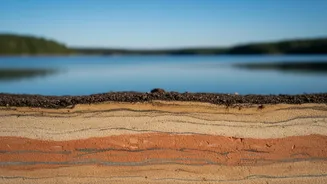
So, how can mud from the bottom of a lake tell us about ancient weather? Lake sediments are like a natural archive, or a history book written page by page, year by year. Everything that falls into or gets washed into the lake eventually settles on the bottom. This includes dust, ash from distant fires, soil from erosion, and, crucially, pollen from surrounding plants. Over centuries and millennia, these materials build up in distinct layers, with the oldest at the bottom and the youngest at the top. By carefully extracting a core, scientists can read these layers and reconstruct a detailed timeline of environmental changes that occurred in and around the lake basin.
Reading the Pollen Record
The science of identifying ancient pollen is called palynology. Pollen grains are incredibly resilient, and their unique shapes allow scientists to identify the type of plant they came from, often down to the specific species. When researchers analyze a sediment layer, they count the different types of pollen present. A layer rich in pollen from grasses and herbs might suggest a dry, open savannah. In contrast, a layer dominated by pollen from forest trees points to a wetter, more humid climate that could support dense woodland. This allows scientists to use pollen as a 'proxy'—an indirect indicator—to reconstruct past vegetation and, by extension, the climatic conditions of the time.
Reconstructing an Ancient Monsoon
The pollen from Raja Rani Lake told a clear story of transformation. The analysis showed a dramatic shift in the local ecosystem. Around 2,500 years ago, the landscape was more of a wooded savannah. But during the period identified as having a stronger monsoon, there was a clear dominance of pollen from moist tropical deciduous forest species. This indicates that the climate became significantly warmer and more humid, with enough rainfall to support a dense forest. This period of intensified monsoon corresponds to a global warm phase known as the Medieval Climate Anomaly. The evidence suggests this was driven by a combination of large-scale climate patterns, including La Niña-like conditions in the Pacific Ocean.
Why These Ancient Clues Matter Today
Understanding what the monsoon did a thousand years ago is not just an academic exercise; it has critical implications for our future. India’s economy, agriculture, and water security are all fundamentally tied to the annual monsoon. By establishing a more accurate historical baseline of natural climate variability, scientists can build better, more reliable models to project future climate scenarios. This research provides crucial data on how the monsoon system responds during warmer global periods. It helps us understand the range of its natural behaviour, which is essential for preparing for the potential impacts of modern climate change on rainfall patterns, droughts, and floods across the subcontinent.