


Passing the Orbital Baton
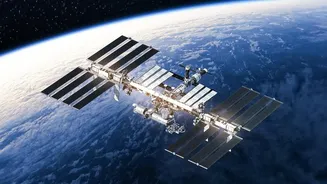
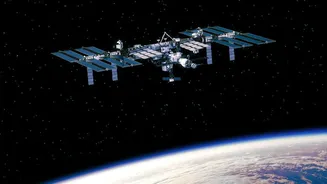
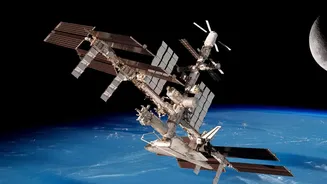
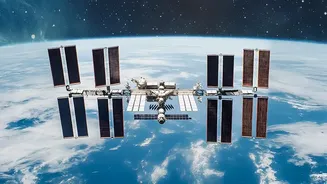
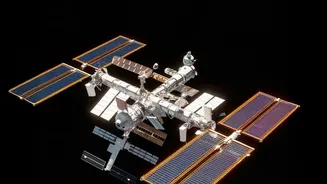
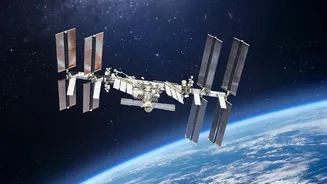
The International Space Station has been a monumental achievement of global cooperation, hosting more than 290 individuals from 26 countries and countless scientific experiments since continuous occupation began in 2000. However, after three decades of service,
the 450,000 kg structure is showing its age. NASA and its international partners have scheduled the station for a controlled deorbit between 2030 and 2031. It will be guided into a remote area of the Pacific Ocean, marking the end of a chapter in space exploration. This transition is not an end but a strategic pivot. Instead of building a new government-owned station, NASA is fostering a commercial marketplace in low-Earth orbit (LEO), planning to be a customer rather than a landlord. The goal is to prevent a gap in US-led orbital activity and accelerate a new space economy.
The Commercial Contenders
Several well-funded companies are racing to become the first commercial landlords in space. Axiom Space, which has already flown private missions to the ISS, is a key player. The company plans to attach its first module, a payload and power unit, to the ISS before eventually detaching to form a free-flying station as early as 2028. Another major initiative is Orbital Reef, a joint effort by Blue Origin and Sierra Space, envisioned as a "mixed-use business park" in orbit. Their design prominently features the Large Integrated Flexible Environment (LIFE) module, an inflatable habitat, and plans to serve clients in research, manufacturing, and tourism. A third frontrunner is Starlab, a joint venture between Voyager Space and Airbus, which is developing a station with a large habitat and a dedicated science park. These ventures are backed by significant private investment and NASA funding through its Commercial LEO Destinations (CLD) program.
Next-Generation Engineering
These new stations are not just replicas of the ISS. They incorporate next-generation engineering to be more efficient, modular, and commercially viable. One of the most significant innovations is the use of inflatable habitats, like Sierra Space's LIFE module for Orbital Reef. These structures launch in a compact form and expand in space, offering a much greater volume-to-mass ratio than traditional rigid metal modules. Axiom Space is working with Thales Alenia Space, an expert in pressurized modules, to build its station components. Another key area is automation and advanced life support. The goal is to reduce the constant maintenance and crew intervention required on the ISS, freeing up more time for revenue-generating science and commercial activities. These stations are designed from the ground up for modularity, allowing them to expand and adapt as market demand grows.
A Marketplace for Orbital Science
The primary business case for these new outposts is science and manufacturing. The microgravity environment offers unique advantages for research that is impossible on Earth. Pharmaceutical companies, for instance, can grow more perfect protein crystals to develop new drugs for diseases like cancer and muscular dystrophy. Materials science is another key area, with the potential to manufacture novel fiber optics or flawless semiconductor crystals for next-generation electronics. Starlab has already announced agreements with biotech firm LambdaVision to produce artificial retinas and with United Semiconductors to advance in-space manufacturing. The commercial model promises to lower barriers to entry, allowing universities, startups, and international agencies to conduct research without the massive cost and bureaucracy of a state-run program. These platforms will also serve as testbeds for technologies needed for future missions to the Moon and Mars.
Beyond the Laboratory
While science is the anchor tenant, the business model for private space stations is diverse. Space tourism is a significant potential revenue stream, with companies planning to offer once-in-a-lifetime experiences for wealthy adventurers. In-space manufacturing, where products are made in orbit for use in orbit, is another burgeoning field, especially for items like 3D-printed spare parts. Even media and entertainment are seen as customers, with the potential for filming movies or hosting unique events in a truly out-of-this-world setting. Axiom Space is even developing orbital data centers. This diversification is crucial for creating a self-sustaining ecosystem in low-Earth orbit, one that doesn't rely solely on government contracts. The vision is to create a dynamic orbital economy where multiple stations serve a variety of customers, much like business parks on Earth.