

A Planet of Extremes
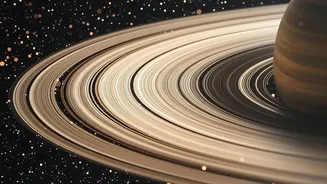
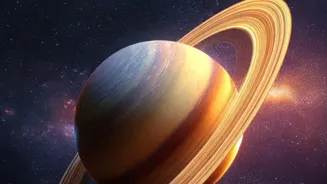
Saturn is a world of superlatives. It is the second-largest planet in our solar system, adorned with a dazzling system of icy rings that stretches for thousands of kilometres. Its sheer scale can be difficult to comprehend, as is the timeline on which
it operates. While Earth completes an orbit around the Sun in a single year, Saturn takes a leisurely 29.5 years. This long journey, combined with a tilt on its axis similar to our own, gives Saturn distinct seasons, but each one lasts for more than seven Earth years. For decades, scientists have tracked these slow-moving seasons, observing how the sunlight falls on different hemispheres, but the full picture of how the atmosphere responds has remained partially hidden.
The Shadow of the Rings
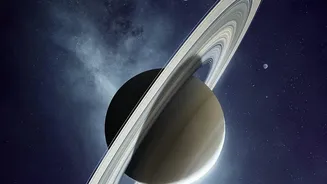
One of Saturn's most unique features is the enormous shadow cast by its own rings. As the planet orbits the Sun, this shadow moves across its face, blanketing vast regions of its atmosphere in darkness. This creates a fascinating natural laboratory. One hemisphere might be enjoying the peak of its seven-year summer, bathed in continuous sunlight, while vast swathes of the other are plunged into a deep, ring-induced winter. Scientists have long theorized that these shadowed regions would experience significant cooling and atmospheric changes, but peering through Saturn's thick upper haze to confirm this has been a major challenge. The shadows themselves aren't just a simple absence of light; they actively influence the temperature and chemistry of the atmosphere beneath them.
Hubble's Infrared Investigation
This is where the Hubble Space Telescope's powerful instruments come into play. While visible light shows the surface of Saturn's clouds, infrared light can penetrate deeper, revealing information about temperature and chemical composition. As part of the Outer Planet Atmospheres Legacy (OPAL) program, Hubble has been conducting yearly observations of Saturn, building a long-term record of its atmospheric changes. These recent infrared observations are particularly crucial. By looking at the heat radiation, or lack thereof, coming from the planet, scientists can map out temperature differences with incredible precision. This allows them to effectively see the cooling effects of the ring shadows and track how the atmosphere responds as the seasons slowly transition. These observations complement those from other missions and telescopes, including the James Webb Space Telescope, to build a three-dimensional picture of the planet's weather systems.
What the New Images Reveal
The latest Hubble data reveals a dynamic and changing world. By analyzing images taken over several years, astronomers have observed noticeable shifts in the planet's atmospheric bands and hazes. For example, older observations from 2020 showed a slight reddish haze over the northern hemisphere, which was then experiencing summer. Scientists theorized this could be due to increased sunlight changing the atmospheric chemistry or removing ices from aerosols. More recent analyses have continued to track these color changes in the bands from year to year. The infrared data helps to connect these visible changes to deeper processes. The shadowed areas are not just colder; their atmospheric chemistry appears to be different, with variations in the amount of photochemical haze produced compared to the sunlit regions. These findings confirm that the rings are not just a static decoration but an active part of Saturn's climate system.
Why This Discovery Matters
Understanding Saturn's seasons helps us understand the fundamental physics and chemistry of gas giant atmospheres. These massive worlds are governed by complex dynamics, and Saturn provides a unique case study due to the influence of its rings. The data gathered by Hubble helps scientists refine their models of planetary atmospheres, which can then be applied to planets outside our own solar system. As Hubble continues its long-term monitoring, it tracks the planet's approach to its 2025 equinox, a time when the rings will be edge-on to the Sun and the shadows will be at their thinnest. This provides a rare opportunity to study the atmosphere without the strong influence of ring-shadow, offering a baseline to better understand the seasonal extremes. Each new observation adds another piece to the puzzle of how these magnificent planets work.