




An Unconventional Experiment
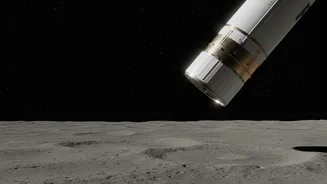
When a piece of space debris, like the spent upper stage of a rocket, slams into the Moon, it’s not just a crash; it’s an unplanned experiment. Unlike meteoroids, which constantly strike the Moon, these human-made objects have known properties: we know their
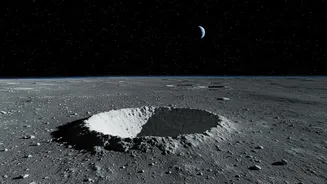
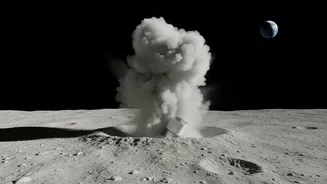
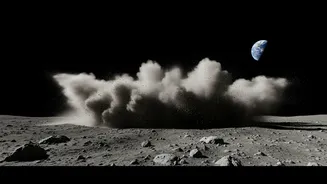
mass, trajectory, and speed. This allows scientists to treat the collision as a controlled test. The impact, which can happen at speeds over 8,000 kilometres per hour, creates a new crater and ejects a massive plume of material from beneath the lunar surface. This provides a rare chance to study what lies just under the Moon's dusty, ancient skin without having to land a complex and expensive drilling mission. Orbiting spacecraft, like NASA's Lunar Reconnaissance Orbiter, can then study both the crater and the ejected debris.
Kicking Up Dust for Deep Insights
The primary goal of observing these impacts is to analyze the cloud of ejected rock and dust, known as an ejecta plume. This material, blasted out from depths that haven't seen sunlight in potentially billions of years, can be analyzed by spectrographs on orbiting satellites. Scientists are particularly hunting for signs of water ice. Finding water is a critical step for future human exploration, as it could be used for drinking water, breathable air, and rocket fuel. NASA successfully used this technique in 2009 with its LCROSS mission, which intentionally crashed a rocket stage into a crater near the lunar south pole and confirmed the presence of water ice. Unplanned impacts, while less precise, offer similar opportunities to peek below the surface and map out potential resources.
The Case of the Wandering Rocket
The idea of a Falcon 9 impact isn't hypothetical. In early 2022, a four-tonne Falcon 9 second stage, left over from a 2015 mission, ended its seven-year journey in space by crashing into the far side of the Moon. It was an uncontrolled but predictable impact. Astronomers tracked the derelict rocket stage, calculating its collision course. While the impact itself wasn't directly observable from Earth, NASA's Lunar Reconnaissance Orbiter was later able to locate and photograph the resulting crater. Surprisingly, it created a unique double crater, suggesting the rocket body had large masses at each end, a detail that provided new information for analysts. These 'accidental' experiments help refine models of crater formation and the physics of the lunar surface, known as regolith.
India’s Tryst with Lunar Impact
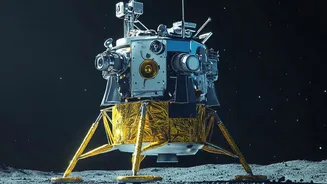
India has its own significant history with this scientific method. In 2008, the Chandrayaan-1 mission deployed the Moon Impact Probe (MIP), a 29-kilogram probe painted with the Indian tricolour. The MIP was intentionally crashed near the Moon's south pole. During its 25-minute descent, its instruments analyzed the thin lunar atmosphere, making one of the earliest detections of water on the Moon. This was a landmark achievement for ISRO, making India the fifth national space agency to reach the lunar surface. The success of the MIP demonstrated the value of impactor missions and provided crucial data that informed subsequent lunar exploration, including the successful soft landing of Chandrayaan-3.