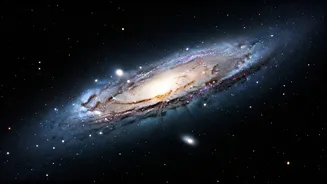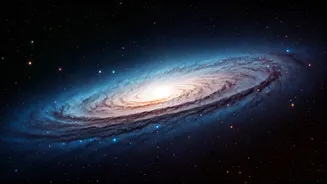



More Than Just a Pretty Picture
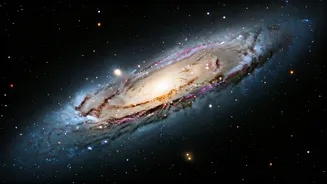
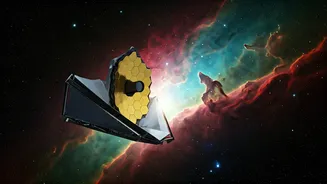
The breathtaking images from the James Webb Space Telescope (JWST) and its predecessors have captured the public imagination. We see swirling clouds of gas and dust in the Pillars of Creation or the kaleidoscopic sparkle of distant galaxies, and our first
instinct is aesthetic appreciation. They are beautiful, awe-inspiring, and perfect for a lock screen. But this is where the problem begins. By focusing solely on their beauty, we strip these images of their true purpose. They are not art; they are data. Each point of light, each swirl of colour, represents a trove of scientific information about the origins of our universe, the birth of stars, and the potential for life beyond Earth. Reducing this profound scientific output to mere decoration does a disservice to the decades of work and the incredible discoveries they represent.
Seeing the Invisible Universe
So, what are we actually seeing? Most of the cosmos is invisible to the human eye. Our eyes can only perceive a tiny sliver of the electromagnetic spectrum known as visible light. Infrared light, which we feel as heat, has longer wavelengths that are invisible to us. Many of the most interesting objects in the universe are either too cool and dim to shine brightly in visible light, or they are shrouded by thick clouds of cosmic dust. Infrared radiation, with its longer wavelengths, can pass through these obscuring dust clouds, much like how sound can travel through walls. This allows telescopes like JWST, Spitzer, and Herschel to peer into stellar nurseries, see the glowing dust of newly forming planetary systems, and detect the faint heat from distant objects that would otherwise be completely hidden from view.
The Birthplaces of Stars and Planets
One of infrared astronomy’s most significant contributions is pulling back the curtain on star and planet formation. Stars are born inside dense, dusty cocoons that are opaque to visible light telescopes. For centuries, these stellar nurseries were mysterious, dark smudges in the sky. Infrared telescopes, however, can penetrate the dust and see the protostars forming within. The Spitzer Space Telescope, for instance, made groundbreaking discoveries about the disks of gas and dust that circle young stars—the raw materials for planets. JWST has taken this a step further, providing incredibly detailed views of these protoplanetary disks and even studying the chemical composition of the material where new worlds are being built, molecule by molecule. This isn't just a pretty picture; it's a snapshot of cosmic construction.
A Window to the Dawn of Time
Infrared astronomy is also our primary tool for cosmology—the study of the universe's origin and evolution. Because light takes time to travel, looking at distant objects is like looking back in time. The most distant galaxies are also the earliest ones we can see. Due to the expansion of the universe, the light from these ancient galaxies has been stretched, or 'redshifted', from visible and ultraviolet light into the infrared spectrum. A normal telescope can't see them. This is why JWST was specifically designed as an infrared observatory. It can capture this ancient, stretched light, allowing astronomers to study the first galaxies that formed less than a billion years after the Big Bang. These are not just faint red smudges; they are clues to how the entire cosmic structure we see today began.
The Art and Science of False Colour
A common misconception is that the colours in infrared images are fake. It's more accurate to say they are translations. Since infrared light has no colour that our eyes can perceive, scientists assign visible colours to different infrared wavelengths to make the data understandable. Typically, the shortest infrared wavelengths are assigned to blue, medium wavelengths to green, and the longest to red. This isn't an arbitrary artistic choice; it's a consistent method for visualizing scientific information. A red area in a JWST image might highlight molecular hydrogen, while a blue area could show ionised gas. These 'false-colour' composites allow scientists, and the public, to distinguish different physical processes and chemical compositions at a glance. The colour is a data visualization tool, turning invisible phenomena into a language we can understand.