



The Sleeping Giants in Every Galaxy
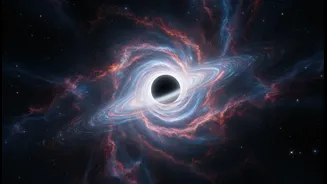
At the heart of nearly every large galaxy, including our own Milky Way, lurks a supermassive black hole (SMBH). These are objects of unimaginable density and gravity, with masses millions or even billions of times that of our sun. For decades, astronomers
believed that most of these giants were dormant or 'quiescent'. Once a galaxy matures, the theory went, its central black hole finishes its meal of nearby gas and dust and settles into a quiet retirement. It no longer radiates the immense energy that characterises an 'active galactic nucleus' (AGN), making it largely invisible except for its gravitational pull on nearby stars. Our galaxy's own black hole, Sagittarius A*, is considered to be in this dormant state.
The Old Story of Galactic Growth
The established theory of galactic evolution painted a fairly linear picture. Galaxies form, they furiously create stars, and their central black hole grows by feeding on surrounding material. At a certain point, the feeding black hole becomes so energetic that its outflow—powerful jets and winds of radiation and plasma—blasts the remaining gas out of the galaxy. This process, known as 'feedback', effectively 'quenches' the galaxy, shutting down star formation. The galaxy grows old, its stars redden, and its central black hole goes dormant. This was thought to be a one-way street, the final chapter in a galaxy's active life.
A Sudden and Unexpected Awakening
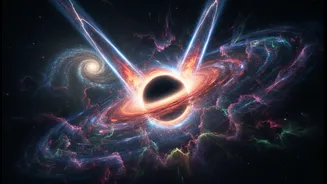
Recent observations have thrown a dramatic wrench into this neat narrative. Astronomers are now observing what was once thought to be rare or impossible: dormant black holes in mature galaxies are suddenly roaring back to life. These reactivations are not subtle. A galactic core that was dark can suddenly flare up, becoming one of the most luminous objects in the universe as it turns back into an AGN. One recent study highlighted a galaxy whose central black hole had been dormant for about 100 million years before suddenly restarting, a process caught mid-cycle by astronomers who could see both the faint remnants of old jets and the bright new ones.
Rewriting the Cosmic Rulebook
This changes everything. If a black hole can turn back on after millions of years of silence, then the 'quenching' process isn't the permanent end state we thought it was. It suggests that the life cycle of a galaxy is not a simple path to retirement, but a more complex, cyclical process of fasting and feasting. The discovery forces major revisions to models of galactic growth. Theorists now have to account for a new mechanism, or a previously underestimated one, that can refuel a dormant black hole in a galaxy that was supposed to be depleted of gas. It means our understanding of how galaxies evolve over billions of years has been incomplete.
The Hunt for a Cosmic Trigger
So what's waking these giants? Scientists are now racing to figure out the trigger. One leading theory, bolstered by new data from the James Webb Space Telescope (JWST), suggests a self-regulating cycle. Gas that was heated and expelled by the black hole's previous active phase may eventually cool down over millions of years, condensing into long, filamentary structures. These streams of cooled gas can then be drawn back by the black hole's gravity, funnelling into its accretion disk and providing the fuel for it to reactivate. Other possibilities include a galaxy capturing a stray gas cloud or a star wandering too close and being torn apart, but the idea of a galaxy recycling its own fuel is gaining significant traction.