




The Inevitable Pull of Drag
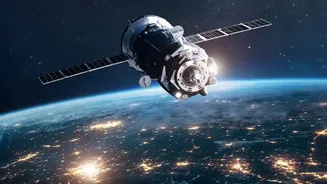
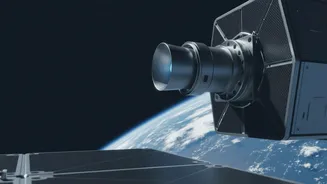
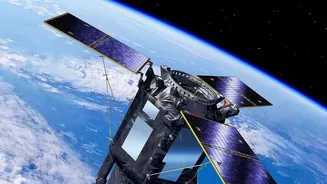
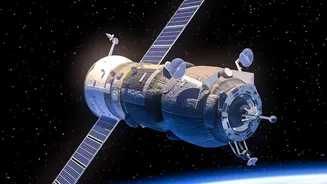
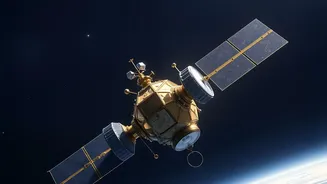
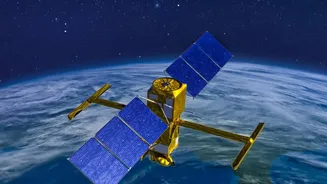
Satellites in low Earth orbit (LEO), which is hundreds of kilometres up, aren't truly in a perfect vacuum. There are still stray atmospheric particles. Over time, colliding with these particles creates drag, slowing the satellite down and causing its
orbit to decay. To counteract this, satellites must periodically fire thrusters to boost themselves back up. This requires carrying propellant, which is heavy, expensive to launch, and, most importantly, finite. Once the fuel runs out, the mission is over, and the satellite eventually burns up in the atmosphere. This fundamental limitation has restricted the lifespan and operational altitudes of many crucial space assets.
A 'Breath' of Fresh Air
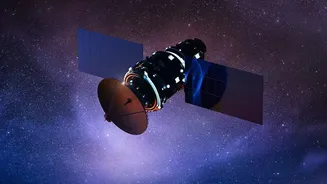
Air-breathing electric propulsion (ABEP), also known as RAM-EP, offers a revolutionary solution. Instead of carrying its own propellant, an ABEP-equipped satellite uses a specialized intake to scoop up the sparse atmospheric particles it encounters. These captured molecules—mostly nitrogen and oxygen—are then channeled into an electric thruster. Inside the thruster, the particles are ionized (given an electric charge) and then accelerated by electromagnetic fields, creating thrust. This thrust is designed to precisely counteract the atmospheric drag, allowing the satellite to maintain its altitude without using any onboard fuel. The entire system is typically powered by solar arrays.
Unlocking a New Orbital Frontier
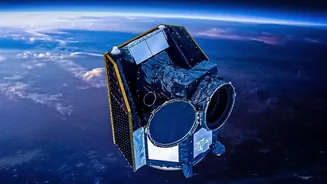
The true game-changer for ABEP technology is the possibility of sustained flight in Very Low Earth Orbit (VLEO), an altitude range roughly between 120 and 300 kilometres. This region has historically been impractical for long-term missions precisely because of the much higher atmospheric drag. Operating in VLEO offers significant advantages. Earth observation satellites can capture much higher-resolution images, and communication satellites can provide services with lower latency. By enabling satellites to conquer drag, ABEP opens up this valuable orbital real estate for a new class of long-duration missions.
What 'Indefinitely' Really Means
While the propellant source—the atmosphere itself—is virtually unlimited, 'indefinite' flight doesn't mean a satellite will last forever. The term refers specifically to the elimination of propellant as a life-limiting factor. The operational lifespan of an air-breathing satellite will instead be determined by the durability of its other components, such as the degradation of solar panels from radiation, the wear and tear on the thruster system, and the resilience of materials against the corrosive effects of atomic oxygen in VLEO. Even so, extending missions from being limited by fuel to being limited by hardware durability represents a massive leap in longevity and mission value.
The Road Ahead
The concept of air-breathing propulsion has been around for decades, but it's only in recent years that research and funding from organizations like the European Space Agency (ESA) have brought it closer to reality. Successful ground tests have already demonstrated that the technology works. In 2018, an ESA-backed team successfully fired a prototype that collected and ionized air molecules in a vacuum chamber simulating an altitude of 200 km. More recently, in March 2026, a project developing a next-generation thruster for ABEP systems passed a key design review with ESA, moving the technology toward hardware development and further testing. While technical hurdles remain in optimizing intake efficiency and ensuring long-term reliability, the technology is steadily moving from the lab toward operational use.