



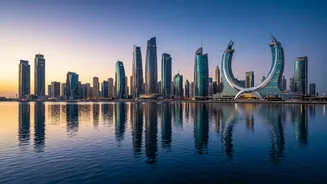


A Gateway to Global Markets
For Indian startups with global ambitions, Dubai offers a compelling proposition. Its strategic location serves as a crossroads between Asia, Europe, and Africa, providing an ideal base for regional and international expansion. Businesses can reach customers
and partners across the Middle East and North Africa (MENA) region with ease. This geographical advantage is backed by world-class logistics and connectivity, turning what might be complex international operations into routine business. Rather than being the final step in a company's growth, international expansion from Dubai can be a core part of a startup's initial strategy, allowing them to build a global company from day one.
Access to Deep Pools of Capital
While India has a vibrant venture capital scene, the funding landscape in the UAE offers a different scale and source of capital. Sovereign wealth funds and a growing number of VC firms are actively looking to invest in technology as part of the region's economic diversification beyond oil. In the first half of 2025 alone, Dubai-based companies attracted 93% of the UAE's tech funding. Initiatives like the 'UAE-India Start-up Series' directly connect high-potential Indian startups with funding opportunities, offering cash, in-kind incentives, mentorship, and investor introductions. This access to diverse funding streams allows Indian founders to scale faster and with greater financial stability.
A Hyper-Efficient Business Environment
One of Dubai's most significant draws is its famously pro-business regulatory framework. Startups can benefit from 100% foreign ownership in free zones, zero personal income tax, and the ability to fully repatriate profits. This contrasts sharply with the often complex tax and compliance burdens in other jurisdictions. Setting up a company is designed for speed, with innovation packages and streamlined licensing in hubs like the Dubai International Financial Centre (DIFC) significantly reducing upfront costs. The government actively supports innovation through initiatives like regulatory sandboxes, which allow startups to test new technologies like fintech and AI in a controlled environment. This forward-thinking approach provides the legal clarity and stability that founders need to focus on growth.
The CEPA and Strategic Partnerships
The UAE-India Comprehensive Economic Partnership Agreement (CEPA), which came into effect in 2022, has been a game-changer. The agreement is designed to boost bilateral trade by reducing tariffs and removing barriers, making cross-border business more seamless. For tech startups, the CEPA includes a dedicated chapter on digital trade, fostering cooperation and creating a more predictable environment for e-commerce and data flows. Beyond trade, the agreement encourages joint ventures and strengthens cooperation between incubators and accelerators in both countries. This formal partnership has supercharged the flow of Indian businesses into Dubai; by the end of June 2026, over 85,800 active Indian companies were registered with the Dubai Chamber of Commerce. A proposed 'AI corridor' between Dubai and Bengaluru further aims to help Indian AI talent use the city as a launchpad for global markets.
Talent, Infrastructure, and Lifestyle
A successful startup ecosystem needs more than just money and friendly regulations; it needs people and infrastructure. Dubai delivers on both fronts. The city is ranked highly for its smart city infrastructure and attracts a global talent pool. For founders and their families, the high quality of life—including safety, world-class schools, and premium healthcare—is a powerful deciding factor. This lifestyle advantage helps companies attract and retain top-tier international talent. Furthermore, government-backed accelerator programs like Dubai Future Accelerators actively connect startups with the resources and mentorship needed to thrive. This blend of hard infrastructure and a supportive community creates an environment where both businesses and people can flourish.