




Why Distance Is Everything
The impact of a large artwork is lost if you can't appreciate it properly. Stand too close, and your eyes get lost in brushstrokes or pixels, unable to see the composition as a whole. Stand too far, and the piece loses its power, failing to command attention.
The goal is to find the 'sweet spot' where you can take in the entire work comfortably without being overwhelmed or underwhelmed. This optimal distance allows the artist's full vision to come to life, creating an immersive experience that engages your entire field of vision. It's the difference between simply seeing a painting and truly experiencing it.
A Simple Formula to Start
Interior designers and gallery curators often use a simple formula to find the ideal viewing distance. First, measure the diagonal of your artwork in inches. Then, multiply that number by 1.5. The result is your starting point for the perfect viewing distance. For example, a 40x60 inch piece has a diagonal of about 72 inches. Multiplied by 1.5, this gives you a viewing distance of 108 inches, or 9 feet. This rule ensures that a viewer is far enough away to appreciate the entire composition at once. It’s a reliable guideline used to make sure a piece fits the scale of a room, preventing you from choosing art that's too large for a space where you can't step back.
Going Beyond the Math
While the formula is a great guide, it isn't absolute. The style and medium of the art play a significant role. A highly detailed, photorealistic work might invite closer inspection, while an abstract impressionist painting with broad, loose brushstrokes often needs more distance for the colors and shapes to blend together visually. Similarly, a piece with heavy texture, like an impasto oil painting, can be appreciated from up close to see the artist's handiwork. Think of the formula as your baseline, but feel free to adjust based on the artwork's specific characteristics and the overall feeling you want to create in the room.
The Context of the Room
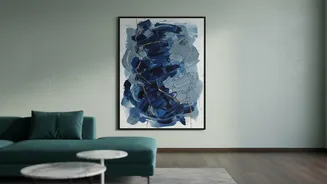
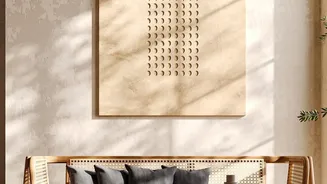
Viewing distance doesn't exist in a vacuum. You also have to consider the room's layout and function. The main viewing distance in a spacious living room will naturally be greater than in a narrow hallway or a cozy bedroom. This is why living rooms can often handle much larger statement pieces than other areas of the home. It's also crucial to consider the art's relationship to furniture. Most designers follow the two-thirds rule: artwork hung above a sofa or console table should be about two-thirds the width of the furniture below it. This, combined with leaving 6-8 inches of space between the top of the furniture and the bottom of the frame, anchors the art and makes it feel connected to the room rather than just floating on the wall.
Height and Lighting: The Supporting Cast
Even with perfect viewing distance, the wrong height can ruin the effect. The most common mistake is hanging art too high. A professional standard is to hang the artwork so its center is 57-60 inches from the floor, which is the average human eye level. This creates a comfortable and balanced look. Lighting is another critical factor. Poor lighting can make any masterpiece fall flat, while direct sunlight can cause colors to fade over time. Consider using adjustable track lighting or a dedicated picture light to highlight your artwork's colors and textures, ensuring it looks its best day and night.