




From Broad Strokes to Fine Details
For years, monsoon forecasts were broad, often covering entire states or large regions. An alert for 'heavy rain' left travellers guessing about the specific conditions on their intended route. The IMD has now enhanced its forecasting capabilities, moving
towards more granular, district-level and even route-specific alerts. This is a significant leap from city-based predictions, aiming to provide weather information for the entire travel corridor. These new systems are powered by an expanding network of Doppler radars and automatic weather stations, allowing for 'Nowcasts'—highly localised warnings for weather events expected within the next few hours. This means you can get specific warnings about intense rain, fog, and strong winds for the exact highway or district you are travelling through.
How to Access the New Forecasts
Accessing this critical information has been made easier through the IMD's digital platforms. The primary resources are the official IMD website (mausam.imd.gov.in) and the 'Mausam' mobile app. The website features a dedicated 'Highway Forecast' section where users can check weather conditions along major routes. The Mausam app provides location-based Nowcasts and colour-coded alerts (Red, Orange, Yellow) for districts, which are crucial for making on-the-go decisions. Some portals even allow users to input a starting point and destination to get a customised forecast that maps out conditions along the journey. Before starting any long drive, especially during the monsoon, make it a habit to check the forecast for key districts on your path.
Your Pre-Journey Route Checklist
A district-level warning is a call to action. It means you need to do more specific research on your route. Before you leave, check for known trouble spots. Look at local traffic police advisories and news reports for information on waterlogging, road closures, or diversions. Pay special attention to routes passing through hilly areas, which are prone to landslides. If an orange or red alert is active for a district on your route, seriously consider its impact. It may be wiser to leave earlier, find an alternative path, or even postpone non-essential travel. Always plan your trip to avoid driving at night, as visibility drops significantly and hazards are harder to spot.
Essential Monsoon Vehicle Checks
Your vehicle is your first line of defence against hazardous conditions. A pre-trip inspection is non-negotiable. Pay close attention to your tyres; the tread depth should be adequate to provide grip on wet surfaces and prevent aquaplaning. Check your brakes, as stopping distances increase on wet roads. Ensure your wiper blades are in good condition and can clear the windshield effectively. A simple walk-around to confirm all lights—headlights, taillights, and indicators—are working is crucial, as they help you see and be seen in heavy rain or fog. Also, keeping your fuel tank full helps prevent moisture from accumulating inside, which can damage the engine, and avoids getting stranded in waterlogged areas.
Smart Driving in Wet Conditions
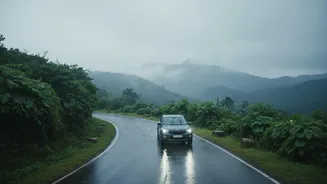
Once on the road, adjust your driving style to the conditions. Reduce your speed and maintain a greater distance from the vehicle in front of you. Avoid sudden braking or sharp turns, which can lead to skidding. Never use cruise control on wet roads, as it can reduce your control if the tyres lose and then suddenly regain traction. One of the most critical rules is to never drive through flooded streets. The water may look shallow, but it can easily hide deep potholes or open drains. If visibility becomes extremely poor, it is safer to pull over at a secure spot and wait for the weather to improve.
Packing for the Unexpected
Your emergency kit needs a monsoon upgrade. Along with a standard first-aid kit, pack a powerful torch, a tow rope, and a basic toolkit. Non-perishable snacks and drinking water are essential in case you are stranded due to a traffic jam or landslide. Keep important documents, electronics, and chargers in waterproof bags. A fully charged phone and a power bank are indispensable for staying updated on weather and traffic information. Finally, an umbrella and some towels are simple but invaluable additions to your monsoon travel kit.