




The First Mistake: Holding Your Breath
The first instinct upon facing a vacuum is to hold your breath. This would be a fatal error. The air trapped in your lungs, under Earth's normal pressure, would expand violently in the absence of external pressure. This would cause a catastrophic rupture
of the delicate alveoli, the tiny air sacs in your lungs, forcing air bubbles directly into your bloodstream. This rapid decompression injury, known as pulmonary barotrauma, would cause near-instant death, far quicker than simple suffocation. The only chance of even brief survival is to exhale completely, letting the vacuum empty your lungs.
Seconds to Unconsciousness
Even if you exhale, the clock is ticking. With no atmosphere to breathe, the gas exchange in your lungs reverses. The vacuum effectively starts pulling oxygen out of your blood. Deoxygenated blood travels from your lungs to your brain, and you would lose consciousness in about 9 to 15 seconds. While survival without permanent damage might be possible if pressure is restored within about 90 seconds, your useful consciousness lasts for only a handful of those precious moments.
The Boiling Point: Understanding Ebullism
One of the most unsettling effects of vacuum exposure is ebullism. It’s a common myth that your blood would boil, but your circulatory system’s elastic pressure prevents this. However, the fluids on the surface of your body and just under the skin are a different story. In a vacuum, the boiling point of water drops to below your body's normal temperature. This means saliva on your tongue, the tears in your eyes, and the water in your soft tissues would begin to vaporize, or 'boil'. This process causes massive swelling, potentially expanding tissues to twice their normal size, though your skin is strong enough to prevent you from actually exploding.
A World of Fire and Ice
You wouldn't instantly freeze solid, another sci-fi trope. Heat transfer in a vacuum is slow because there's no air for conduction or convection. Instead, you'd face a battle of thermal extremes. Any part of your body facing the sun would be exposed to unfiltered radiation, with temperatures soaring to 120°C, causing severe burns. Simultaneously, any part in shadow would plummet to as low as -150°C. This wild temperature swing would create a state of severe thermal shock. The water vaporizing from your skin and mouth would also have a rapid cooling effect, leading to surface frost.
The Spacesuit as a Personal Spaceship
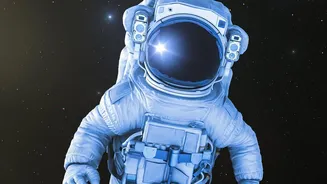
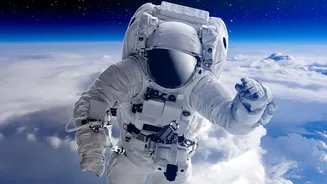
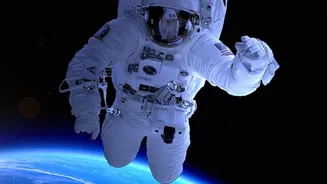
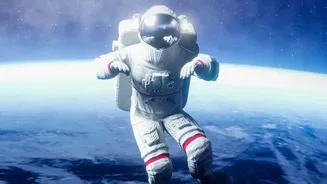
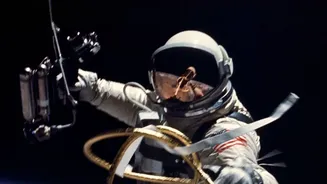
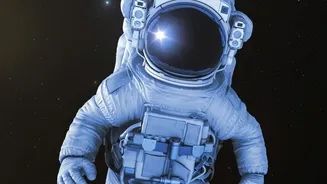
This grim reality is why a spacesuit, or Extravehicular Mobility Unit (EMU), is far more than an outfit. It's a self-contained environment engineered to counteract every lethal threat space throws at it. Its primary function is providing pressure. The suit is inflated with pure oxygen at a lower pressure than on Earth, which is enough to prevent ebullism while allowing for more flexibility. A backpack life-support system provides breathable oxygen and scrubs the carbon dioxide you exhale.
Layers of Protection
To manage the extreme temperatures, astronauts wear a Liquid Cooling and Ventilation Garment underneath the main suit. This network of tubes circulates cool water to draw away body heat. The suit's outer layers are a marvel of material science, comprised of materials like Teflon, Kevlar, and Nomex. This multi-layered shell provides insulation against temperature swings, shields against solar radiation, and is tough enough to protect against micrometeoroid impacts—tiny debris particles traveling many times faster than a bullet. Finally, a gold-lined visor on the helmet protects the astronaut's eyes by reflecting the sun's harsh, unfiltered light.