

The Standard Cosmic Story
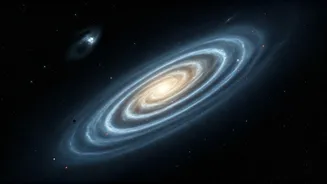
For decades, the prevailing theory of cosmic evolution, known as the Lambda-CDM model, has been our guide. It tells a story of gradual growth. After the Big Bang, small clumps of dark matter began pulling in gas, slowly forming the first, tiny 'baby'
galaxies. Over billions of years, these small structures were expected to merge and collide, building ever-larger galaxies in a process called hierarchical formation. According to this cosmic rulebook, the universe's most massive galaxies and galaxy clusters—collections of hundreds or thousands of galaxies bound by gravity—should be relatively recent arrivals, forming much later in the universe's 13.8 billion-year history. This bottom-up approach seemed to explain the structure of the universe we see around us today. Until now.
An Impossible Early Universe
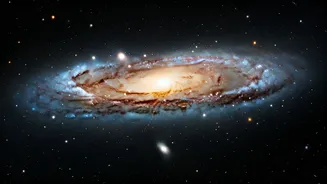
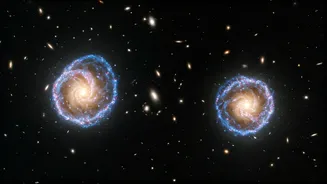
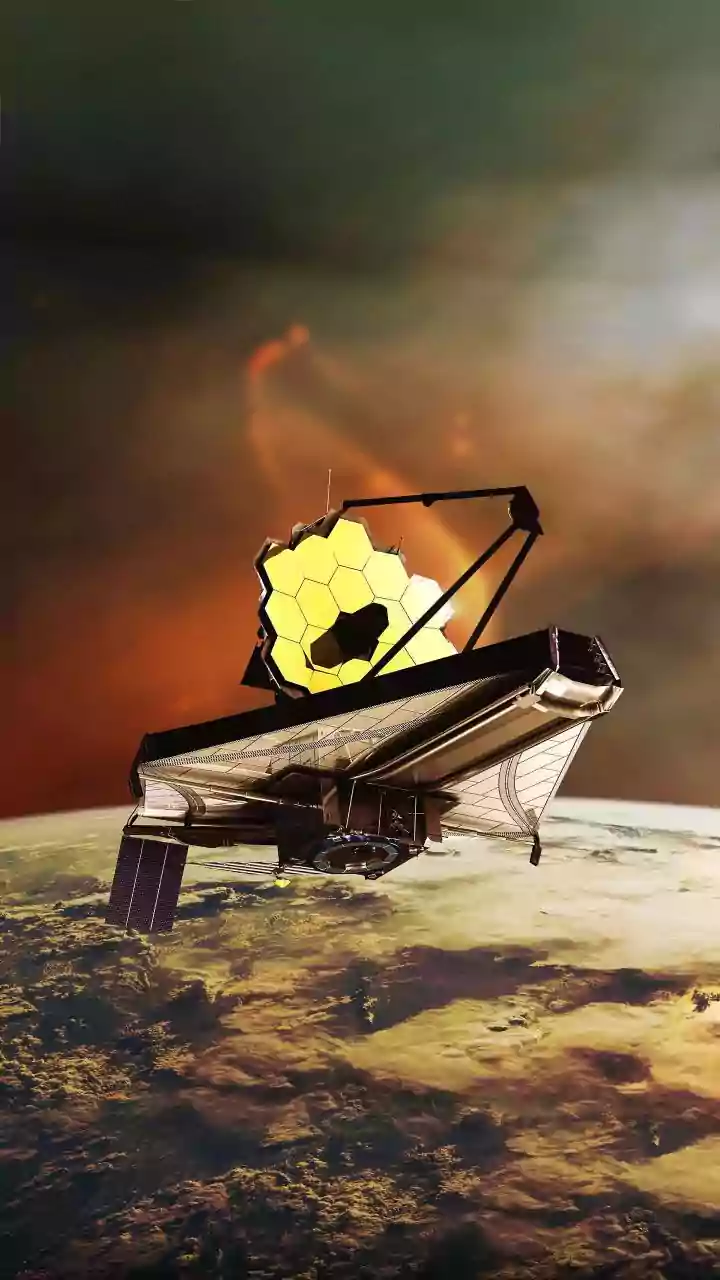
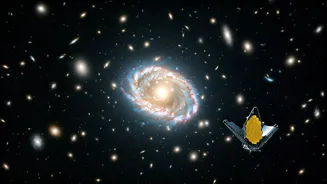
Enter the James Webb Space Telescope (JWST). With its powerful infrared eyes, it can peer back to the dawn of time, observing light that has traveled for over 13 billion years. And what it's finding is confounding astronomers. In what was supposed to be the universe's infancy, just 500-700 million years after the Big Bang, JWST has spotted galaxies as mature and massive as our own Milky Way. Scientists have informally nicknamed them 'universe breakers' because their existence simply shouldn't be possible according to the standard model. One recent discovery identified a 'protocluster'—a galaxy cluster in its violent formation phase—when the universe was only about a billion years old, a one to two billion year jumpstart on what was previously thought possible.
Too Big, Too Soon
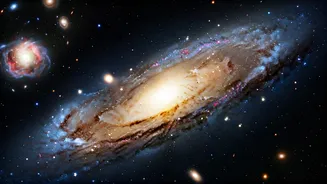
The problem is one of both size and speed. Standard models predict that at this early stage, there simply hasn't been enough time for gravity to gather that much matter into one place. Finding a massive protocluster like JADES-ID1, with a mass 20 trillion times that of our sun, so early in cosmic history is like finding a skyscraper in a village that just learned how to make mud huts. These early galaxies also appear surprisingly complex. Instead of being chaotic messes of gas, some already show signs of rotating disks and significant amounts of cosmic dust—a by-product of dying stars, suggesting a whole generation of stars had already lived and died. The known mass in stars at this period might be up to 100 times greater than what was once believed.
Rewriting the Beginning
These findings have sent scientists scrambling back to the drawing board. The tension between JWST's observations and the Lambda-CDM model is significant. Either our understanding of galaxy formation is fundamentally wrong, or the cosmological model itself needs to be altered. Perhaps galaxies were simply far more efficient at converting gas into stars than we knew, allowing them to grow much more rapidly. Other, more radical theories are also being explored, suggesting that the universe could be older than we think, or that the nature of dark matter—the invisible scaffolding upon which galaxies are built—is different from what we've assumed. Some findings even hint that the seeds of these giant structures, like supermassive black holes, may have formed through unknown processes in the earliest moments of the universe.