



The Coolest Spot in the Universe
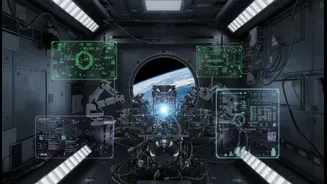
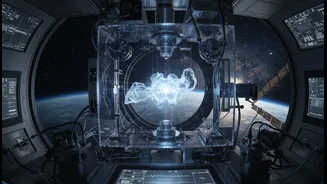
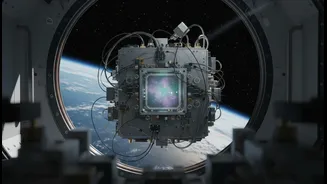
Since its installation on the International Space Station (ISS) in 2018, the Cold Atom Laboratory (CAL) has been remotely operated by scientists on Earth to perform experiments impossible to replicate on the ground. Its mission is to cool atoms down to a fraction
of a degree above absolute zero, the theoretical point where all atomic motion ceases. Using a complex system of lasers and magnetic fields, CAL chills clouds of atoms like rubidium and potassium to temperatures more than 100 million times colder than deep space, creating an exotic state of matter that allows scientists to observe quantum phenomena at a macroscopic level. Recent upgrades to the facility have expanded its capabilities, allowing for even more advanced investigations into the fundamental nature of matter.
Creating the Fifth State of Matter
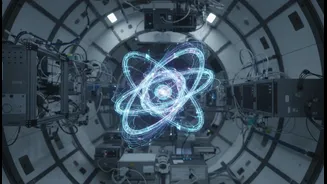
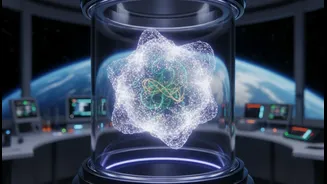
When atoms are cooled to these extreme temperatures, they stop behaving like individual particles and start to overlap, acting as a single entity or 'super atom'. This collective state is known as a Bose-Einstein Condensate (BEC), often called the fifth state of matter, distinct from solids, liquids, gases, and plasmas. Predicted by Satyendra Nath Bose and Albert Einstein in the 1920s, BECs were not created in a lab until 1995. In a BEC, the bizarre rules of the quantum world—where particles can act like waves and be in multiple places at once—become visible on a much larger scale, making them easier to study. CAL was the first facility to produce a BEC in Earth's orbit.
Why Microgravity is the Perfect Laboratory
On Earth, gravity is a major spoiler for quantum experiments. The delicate, ultra-cold atom clouds are quickly pulled downwards, limiting observation times to mere fractions of a second. In the microgravity environment of the ISS, these condensates can float freely, allowing scientists to observe them for much longer periods—up to several seconds. This extended observation time is critical. It allows for more precise measurements and enables experiments that are simply not feasible on the ground, such as creating bubble-shaped quantum gases that would collapse instantly under gravity. This unique setting helps researchers probe the fundamental properties of matter with unprecedented accuracy.
Pioneering Next-Generation Sensors
The research isn't just about understanding the universe; it has profound practical applications. The extreme sensitivity of these ultra-cold atoms to external forces makes them ideal for building a new generation of quantum sensors. This is where 'atom interferometry' comes in—a technique that uses the wave-like properties of atoms to measure forces like gravity with incredible precision. Space-based quantum sensors developed from this research could lead to revolutionary technologies, including ultra-precise atomic clocks and next-generation navigation systems for spacecraft that don't rely on GPS. On Earth, similar technology could be used for geodesy (studying Earth's shape and gravitational field), prospecting for water and minerals, and monitoring environmental changes.