






A World of Possibility
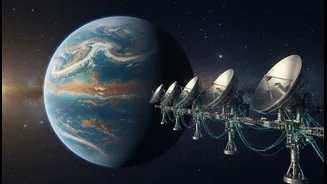
Located 124 light-years away in the constellation Leo, K2-18b is no ordinary exoplanet. It’s what’s known as a sub-Neptune, larger than Earth but smaller than Neptune, and it orbits its star within the habitable zone. This is the “Goldilocks” region where
temperatures could be just right for liquid water to exist on a planet's surface. Adding to the intrigue, observations from the James Webb Space Telescope (JWST) have detected carbon-based molecules and water vapour in its atmosphere. This has made K2-18b a prime candidate for a “Hycean” world—a hypothetical planet with a global water ocean beneath a hydrogen-rich atmosphere. These tantalising clues are why scientists have pointed some of our most powerful instruments in its direction.
Listening for Alien Tech
The recent search wasn’t just looking for any kind of life; it was specifically hunting for “technosignatures.” Think of these as cosmic breadcrumbs left by an advanced civilization. While a biosignature might be a gas produced by microbes, a technosignature is evidence of technology itself. This could be anything from massive orbital structures to industrial pollution or, in this case, artificial radio signals. The Search for Extraterrestrial Intelligence (SETI) often focuses on narrow-band radio transmissions because they don't typically occur naturally and are an efficient way to communicate across interstellar distances. Finding such a signal would be a clear, unambiguous sign of intelligent life.
The Search and the Silence
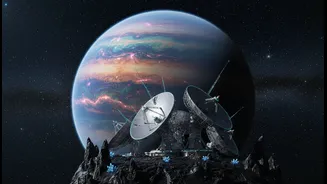
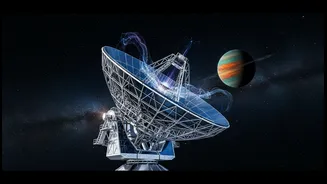
To listen for these signals, a team of researchers conducted one of the most sensitive searches of its kind. The project, led by scientists from the SETI Institute, used two powerful radio telescope arrays in tandem: the Very Large Array (VLA) in New Mexico and the MeerKAT in South Africa. This coordinated effort allowed for broad and continuous coverage of the K2-18b system. For 33 days—the length of a full year on the planet—they scanned a wide range of radio frequencies. The telescopes picked up millions of potential signals, but the real work was in filtering out the noise. After a painstaking, five-step process to eliminate Earth-based interference and other false positives, not a single credible technosignature remained.
Why Silence Is Not Failure
So, does this mean K2-18b is lifeless? Not at all. A null result in science is still a result, and an important one at that. This search only ruled out one specific possibility: that a civilization on K2-18b is broadcasting powerful, persistent, narrow-band radio signals in our direction. The search's sensitivity was high enough to detect a transmitter with power comparable to the iconic (and now-collapsed) Arecibo Observatory. If a civilization is there, it’s either not broadcasting, using a technology we can’t detect, or simply isn't transmitting with that much power. More importantly, this effort has successfully demonstrated and refined a powerful new method for sifting through massive amounts of data, which will be crucial for future searches with even more advanced telescopes.
The Quest Continues
The search for life on K2-18b is far from over. This radio silence complements other ongoing investigations, including those by the JWST. In recent years, there has been a vigorous scientific debate over a tentative detection of dimethyl sulfide (DMS) in the planet's atmosphere—a gas on Earth primarily produced by marine life. While this potential biosignature is still highly contested, with some studies unable to confirm it, it highlights that the search for life is a multi-faceted process. We are looking for both primitive life (biosignatures) and intelligent life (technosignatures). Each search, whether it ends in a detection or a meaningful silence, brings us one step closer to understanding our place in the universe. The hunt for answers on K2-18b and beyond will undoubtedly continue.