



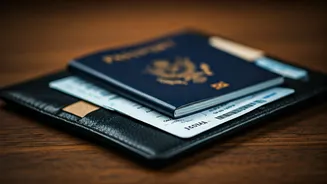




Understanding the Visa-on-Arrival Rule
For most Indian passport holders, a trip to the dazzling cities of Dubai or Abu Dhabi requires a pre-arranged visa. However, a convenient exception exists: the visa-on-arrival (VOA) facility. This isn't an open-door policy for everyone. It is a conditional
entry permit specifically for Indian citizens who hold certain documents from other specific countries. The core requirement is that you must possess a valid visa or residence permit from a select group of nations to qualify. If you don't hold one of these specific documents, you cannot simply get a visa stamped at the airport and will need to apply for a standard UAE tourist visa in advance. Getting this wrong can be costly, as airlines will deny boarding at your departure airport in India if your paperwork doesn't meet the stringent UAE immigration requirements.
What Are 'Valid Third-Country Papers'?
The term 'third-country papers' refers to a valid visa or residence permit issued by a specific list of foreign countries. As of 2026, the UAE has expanded the list of qualifying documents for Indian nationals. To be eligible for the 14-day visa-on-arrival, you must hold a valid visa or residence permit from one of the following countries: the United States, the United Kingdom, any European Union member state, Canada, Australia, New Zealand, Japan, South Korea, or Singapore. For example, an Indian passport holder with a valid US B1/B2 tourist visa, a US Green Card, or a UK Biometric Residence Permit would qualify. The key is that it must be a valid, unexpired document. A tourist visa from Australia or Canada, for example, does not qualify; it must be a residence permit from those countries. This facility was designed to streamline travel for Indians who are globally mobile.
The Six-Month Validity Rule is Crucial
One of the most common reasons travellers are denied boarding is a misunderstanding of the validity requirements. It is not enough for your third-country document to simply be valid on your date of travel. Both your Indian passport and your qualifying third-country document (e.g., your US visa or EU residence card) must be valid for at least six months from the date you plan to enter the UAE. An airline check-in agent will verify this. If your UK residence permit expires in five months, for example, you will not be allowed to board the flight, even if your passport is valid for years. Always check the expiration dates on all your documents well before your travel date.
Your Essential Document Checklist
If you believe you qualify for the visa-on-arrival, ensure you have the following documents ready to present to both the airline and UAE immigration officers. You should carry the original documents, as photocopies or digital images are often not accepted. Original Indian Passport: Must be valid for at least six months from your entry date. Original Qualifying Document: Your valid US visa, Green Card, or residence permit from one of the nine eligible countries. This must also be valid for at least six months. Visa Fee: The 14-day visa-on-arrival costs AED 100 (approximately ₹2,300), payable at the immigration counter. Some reports mention a fee of USD 63. Confirmed Return Ticket: Airlines require proof that you plan to leave the UAE. * Proof of Accommodation: It is wise to carry a copy of your hotel booking or details of where you will be staying.
What If I Don't Qualify?
If you are an Indian passport holder without a qualifying visa or residence permit from one of the nine specified countries, you are not eligible for the visa-on-arrival. This is the case for the majority of travellers from India. In this situation, you must apply for a pre-arranged UAE visa before you travel. This is a straightforward online process. You can apply for various types of e-Visas, including 30-day or 60-day tourist visas, through airline websites like Emirates or Etihad, or via authorized travel agents and visa service providers. The processing time is typically a few working days, so be sure to apply well in advance of your planned trip to avoid any last-minute complications.