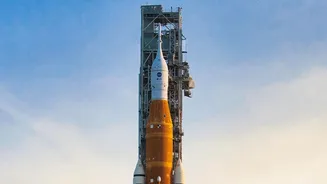




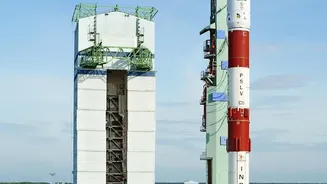
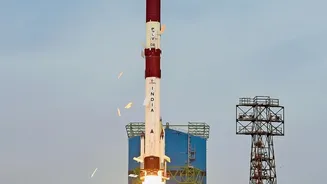
The Problem with 'Disposable' Rockets
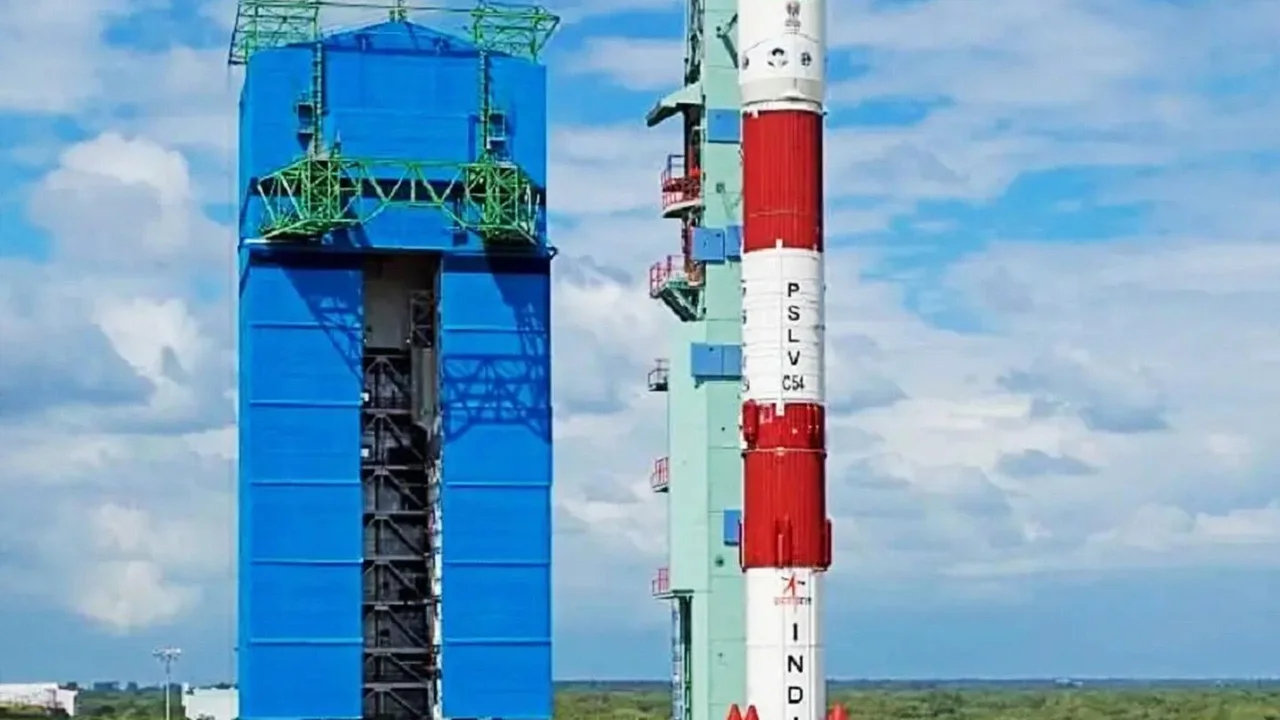
Imagine buying a brand-new airplane, flying it once from Mumbai to Delhi, and then throwing it away. That's essentially how traditional space launches have worked. The massive, powerful rockets that carry satellites into orbit are complex machines that are discarded
after a single flight, burning up in the atmosphere or falling into the ocean. This makes accessing space an extremely expensive endeavour. Nearly 80% of a launch vehicle's cost is tied up in its structure and engines, not the fuel. By treating this sophisticated hardware as disposable, the cost of placing even a small satellite into orbit runs into millions of dollars, limiting access for many companies and scientific projects.
Enter Pushpak: India's Space Plane
The Indian Space Research Organisation (ISRO) is tackling this problem head-on with its Reusable Launch Vehicle - Technology Demonstrator (RLV-TD) programme. The centerpiece of this initiative is a winged vehicle nicknamed 'Pushpak'. Unlike conventional rockets that fall back to Earth, Pushpak is designed to function like a space plane. After its mission in space, it re-enters the atmosphere and glides to a runway, landing horizontally just like a commercial aircraft. This ability to be recovered and refurbished for multiple missions is the key to unlocking massive cost savings and transforming the economics of space access.
Mastering the Autonomous Landing
The most critical and challenging part of this entire concept is the landing. A vehicle returning from space is travelling at immense speed, and it must be able to navigate, slow down, and land on a specific runway without any human pilot on board. ISRO has been systematically proving this capability through a series of tests known as the Landing Experiments (LEX). In these tests, a prototype of Pushpak is carried to an altitude of 4.5 kilometres by a Chinook helicopter and released. The vehicle then has to autonomously navigate, make corrections for wind and position, and execute a perfect, high-speed landing. Following a hat-trick of successful LEX missions, ISRO has demonstrated its mastery over this crucial autonomous technology, even under challenging conditions.
The Multi-Crore Rupee Question: How Much Cheaper?
The ultimate goal is to drastically slash the cost of launching payloads into space. By reusing the most expensive parts of the rocket, ISRO aims to reduce launch costs by an order of magnitude. Projections suggest that a fully realised reusable launch system could cut the cost of sending a payload to Low Earth Orbit by as much as 80 percent. The target is to bring the cost down from the current global average, which can be as high as $20,000 per kilogram, to a much more accessible figure, potentially around $4,000 per kg or even lower. This financial revolution would make India an even more competitive player in the multi-billion dollar global satellite launch market.
What Comes Next on India's Reusable Roadmap?
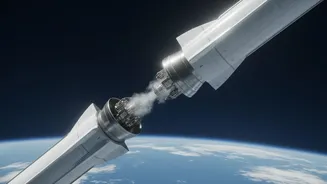
The successful completion of the landing experiments is a vital step, but it's not the final destination. These tests simulated the final phase of a space mission. The next major challenge for ISRO is the Orbital Re-entry Vehicle (ORV) experiment. This will involve launching a scaled-up version of Pushpak into orbit on a conventional rocket. The vehicle will then have to endure the harsh conditions of re-entering Earth's atmosphere at hypersonic speeds before performing its now-proven autonomous landing. Mastering this full cycle will pave the way for India's first fully reusable, two-stage-to-orbit (TSTO) launch vehicle, solidifying India's position as a leader in sustainable and affordable space technology.