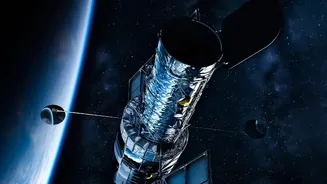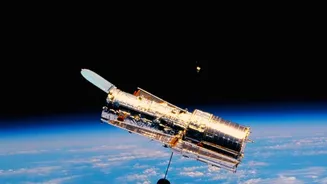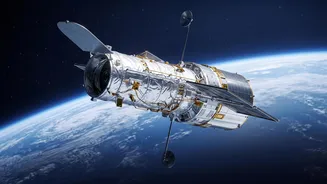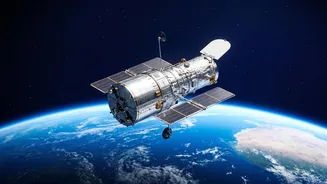





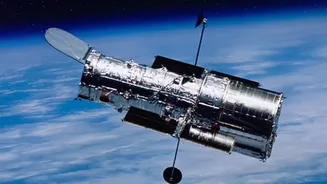
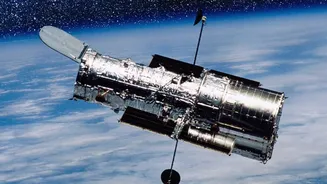
For over 35 years, the Hubble Space Telescope has been humanity’s tireless eye on the cosmos, revolutionizing our understanding of the universe. But its legendary journey is threatened by a slow, inevitable descent toward Earth.
The Slow, Unavoidable Fall
Hubble has no engine to
maintain its altitude. Since its last servicing mission by a Space Shuttle crew in 2009, atmospheric drag, though incredibly thin 500 kilometres up, has been steadily pulling the observatory downward. This process, known as orbital decay, means that if nothing is done, Hubble is projected to make an uncontrolled reentry into Earth’s atmosphere sometime in the mid-2030s. Increased solar activity has recently accelerated this decay, making the timeline more urgent. To prevent a potentially hazardous uncontrolled reentry and, more importantly, to prolong Hubble's invaluable scientific mission, NASA needs to find a way to push it back up to a higher, more stable orbit.
What is a 'Re-Boost' Mission?
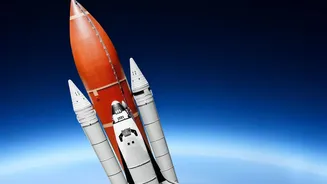
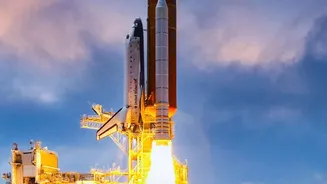
A re-boost is exactly what it sounds like: a mission to give the telescope a push into a higher orbit. In the past, this was a routine part of Space Shuttle servicing missions. Astronauts would visit Hubble, perform repairs and upgrades, and use the shuttle's own jets to nudge the observatory to a higher altitude, extending its life. The final re-boost occurred in 2002. With the shuttle fleet retired in 2011, NASA lost its purpose-built vehicle for servicing the iconic telescope. Any new mission would require a different approach, one that leverages the capabilities of the modern aerospace industry.
NASA's Call for Commercial Partners
In a significant shift in strategy, NASA has turned to the private sector for solutions. In late October 2026, the agency issued a formal Request for Information (RFI), asking commercial space companies for ideas on how they could perform a Hubble mission. The request outlines three possibilities: a re-boost to a stable orbit of at least 600 kilometres, a servicing mission to potentially upgrade its instruments, or a controlled de-orbit to safely dispose of the telescope at the end of its life. This isn't a funded contract yet; rather, it is NASA's way of surveying the market to see what is technically feasible and what it might cost. Responses are due by the end of November 2026.
Who Could Answer the Call?
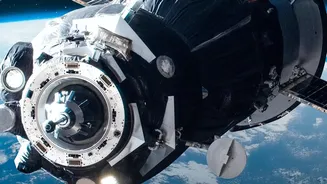
The most prominent name linked to a potential Hubble mission is SpaceX. In 2022, NASA and SpaceX conducted a joint, unfunded study to assess the feasibility of using a Dragon spacecraft for a re_boost. The study was proposed in partnership with the Polaris Program, a private human spaceflight initiative led by billionaire and now_NASA Administrator Jared Isaacman. While that initial concept did not move forward at the time, the new RFI re_opens the door. However, the field is wider now. The growing satellite_servicing industry includes companies like Northrop Grumman and startups such as Astroscale and Momentus, which have developed robotic solutions for in_orbit tasks. NASA's call is open to any company with a viable concept, whether it's a crewed mission or a fully robotic one.
A New Model for Sustaining Space Assets
This initiative represents more than just a plan to save a beloved telescope; it signals a new era in space operations. By seeking commercial solutions, NASA is helping to create a market for in_space servicing, a critical capability for the future of space exploration and infrastructure. If a private company can successfully and costeffectively re_boost Hubble, it could pave the way for similar missions to service, refuel, or relocate other valuable satellites, both government and commercial. As NASA plans for future flagships like the Habitable Worlds Observatory, it is designing them with servicing in mind from the start. The effort to save Hubble could therefore serve as a crucial test case, proving out the business model for keeping assets productive in orbit for decades to come.