




An Awakening Star
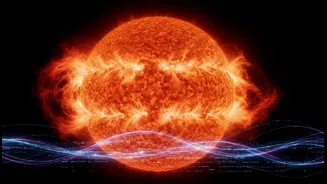
The Sun operates on an approximately 11-year cycle, moving from a quiet period (solar minimum) to a peak of activity (solar maximum). We are currently in Solar Cycle 25, which began in December 2019. While initial forecasts predicted this cycle would
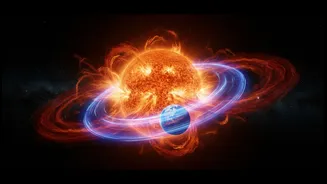
be relatively weak, similar to the previous one, the Sun has been consistently more active than anticipated. This heightened activity, marked by an increase in sunspots, solar flares, and eruptions, is why scientists are paying such close attention. These phenomena are not just beautiful celestial events; they are the drivers of space weather that can reach across 150 million kilometres to affect us here on Earth.
What Is Space Weather?
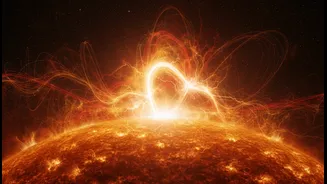
Space weather refers to the changing conditions in space, driven by the Sun's activity. The main events are solar flares and Coronal Mass Ejections (CMEs). A solar flare is an intense burst of radiation, while a CME is a massive eruption of plasma and magnetic field from the Sun's outer atmosphere, the corona. When these eruptions are directed towards Earth, they can interact with our planet's magnetic field and upper atmosphere. This interaction is what can cause problems, creating geomagnetic storms that can disrupt our technological infrastructure.
A Risk to Our Digital World
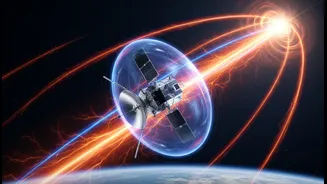
In a world deeply dependent on technology, a severe space weather event poses a significant threat. Geomagnetic storms can induce extra electrical currents in power grids, potentially leading to widespread blackouts. Satellites, crucial for communication, weather forecasting, and GPS navigation, are particularly vulnerable. The high-energy particles can damage their electronics, degrade solar panels, and even alter their orbits. This can disrupt everything from air traffic control and shipping to the financial transactions and navigation apps we use on our phones every day.
India’s Eye on the Sun
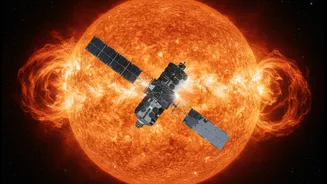
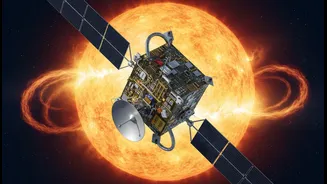
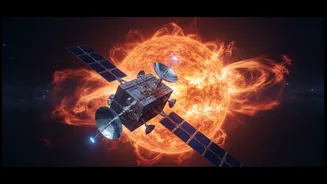
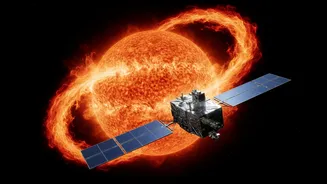
Recognising these risks, India has significantly stepped up its space weather monitoring capabilities. The Indian Space Research Organisation's (ISRO) Aditya-L1 mission is a landmark project in this effort. Launched in September 2023, Aditya-L1 is positioned at Lagrange Point 1 (L1), a unique spot 1.5 million kilometres from Earth that allows for continuous observation of the Sun without any obstruction. Its suite of seven payloads provides crucial data on the corona, solar emissions, solar wind, flares, and CMEs, helping to understand and forecast solar events. Data from Aditya-L1 is already providing new insights and is being made available to the Indian scientific community to maximise research and predictive capabilities.
A Coordinated Global Watch
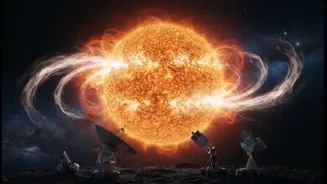
Protecting against space weather is a global challenge that requires international cooperation. Initiatives like the International Space Weather Initiative (ISWI), facilitated by the United Nations, bring together scientists and instrument arrays from around the world to share data and advance space weather science. Agencies like NASA and NOAA in the United States also run dedicated monitoring programs, launching new satellites and observatories to get a more detailed picture of solar activity. This global network of eyes on the Sun provides the early warnings needed to take protective measures, such as temporarily shutting down sensitive satellite components or adjusting power grid operations to mitigate the impact of an incoming solar storm.