


Piercing the Cosmic Veil
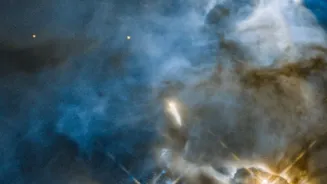
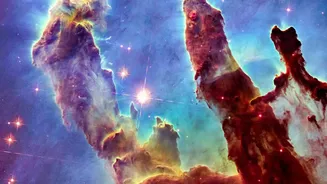
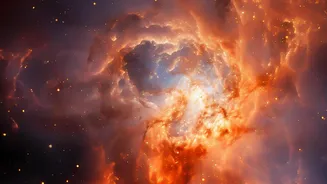
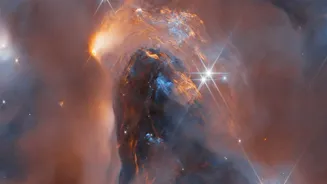
Imagine trying to watch a sculptor work inside a dusty workshop from across the street. All you would see is a hazy cloud. For decades, this was the challenge astronomers faced when studying star nurseries like the Carina or Orion Nebulae. These regions
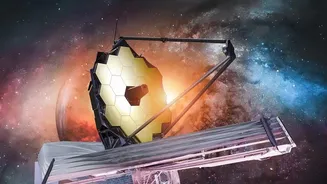
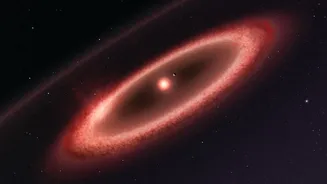
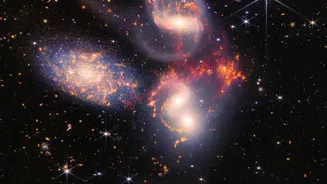
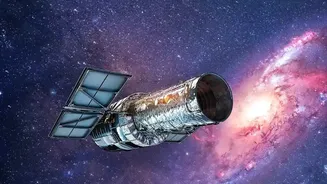
are thick with interstellar dust that blocks visible light, shrouding the very beginnings of stars and planets. The James Webb Space Telescope (JWST) was engineered to solve this exact problem. By observing the universe in infrared light, which can pass through these dense dust clouds, the telescope effectively pulls back the curtain. This allows scientists to witness the processes unfolding within the protoplanetary disks—the swirling platters of gas and dust that orbit young stars and provide the raw materials for planets.
A Chemical Inventory of New Worlds
One of JWST's most revolutionary capabilities is its use of spectroscopy, which analyzes the light passing through a substance to determine its chemical makeup. Using instruments like the Mid-Infrared Instrument (MIRI), astronomers are creating a chemical inventory of these planet-forming disks for the first time. The initial findings are stunning. Webb has detected a rich and diverse cocktail of molecules, including water, carbon dioxide, carbon monoxide, and complex organic hydrocarbons like benzene. These are the fundamental building blocks for both rocky, terrestrial planets like Earth and gas giants like Jupiter. By seeing what materials are present in the 'inner disk'—the zone where rocky planets form—scientists can begin to understand the starting conditions that lead to different kinds of planetary systems across the galaxy.
From Icy Grains to Gas Giants
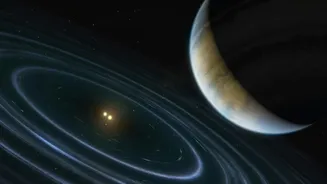
The data from Webb is helping to refine models of planet formation, which is essentially a race against time. The process begins with microscopic dust grains, smaller than a grain of sand. In the cold outer regions of the disk, molecules like water and carbon dioxide freeze onto these grains, creating icy coatings. These sticky grains then begin to clump together, growing from pebbles into boulders, and eventually into the cores of giant planets. Meanwhile, the star itself is trying to blow all this material away with powerful stellar winds and radiation. JWST's observations have revealed that this process of 'disk dispersal' is complex and changes over time, with powerful jets dominating early on. For a gas giant to form, it must accumulate its massive atmosphere before all the surrounding gas is blown away. Seeing this process in action across many young star systems is helping astronomers build a timeline for planet creation.
A New Era of Cosmic Discovery
Recent observations have highlighted just how diverse these cosmic nurseries are. In one system, Webb found a disk surprisingly rich in carbon-based compounds but with less water than expected. In another, a survey of the NGC1333 star cluster revealed several newborn Jupiter-sized worlds, giving insight into how the most massive planets form. The telescope is also revealing that planet-forming disks around smaller, low-mass stars can last much longer than previously thought—up to 30 million years—potentially giving planets in those systems more time to grow. Each observation adds another crucial piece to the puzzle, moving our understanding from broad theories to a detailed, evidence-based story of planetary evolution. The sheer sensitivity of JWST is allowing astronomers to explore these questions with a level of detail that was previously unimaginable.