





A Telescope the Size of a Continent
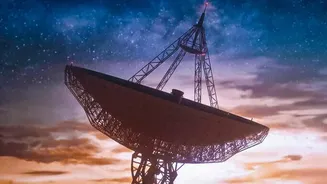
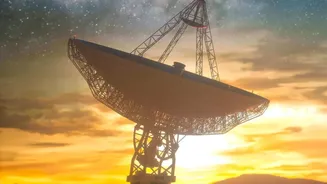
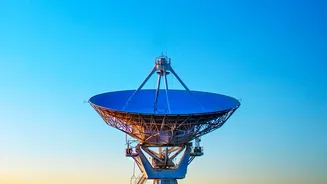
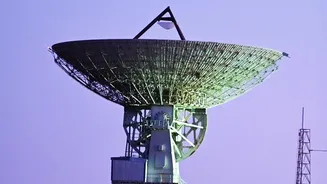
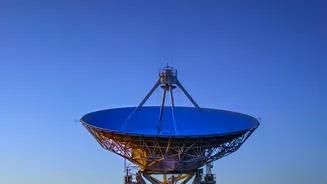
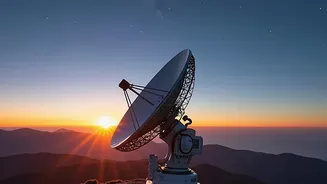
First, it’s important to understand that the Square Kilometre Array (SKA) isn't a single telescope. It is a revolutionary observatory comprised of two vast networks of antennas located in the radio-quiet deserts of South Africa and Western Australia.
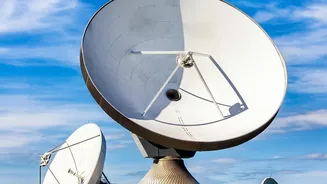
One part, SKA-Mid in South Africa, consists of hundreds of dish antennas, while the other, SKA-Low in Australia, will use over 131,000 Christmas-tree-like dipole antennas. When combined, their total collecting area will eventually be one square kilometre, making the SKA 50 times more sensitive than any previous radio instrument. This sheer scale is the first part of the answer: to detect an incredibly faint signal, you need an enormous 'ear' to listen with.
Tuning In to the Cosmic Dawn
The faint signals the SKA is searching for come from a period known as the Epoch of Reionization (EoR). This was a transformative era, about 500 million to one billion years after the Big Bang, when the first stars and galaxies ignited and their light began to burn through the dark, neutral hydrogen gas that filled the early universe. The signal from this neutral hydrogen, known as the 21-cm line, is incredibly weak. As this ancient radio wave has travelled across the expanding universe for billions of years, its wavelength has been stretched, making it even fainter and harder to detect by the time it reaches Earth. The SKA is specifically designed to be sensitive to these low-frequency radio waves.
The Power of a Collective Ear
The secret to the SKA's incredible power lies in a technique called interferometry. Instead of relying on one giant, physically impossible dish, the observatory links thousands of smaller antennas together electronically. Signals from a cosmic source arrive at each antenna at slightly different times. By using highly precise atomic clocks to timestamp each signal's arrival, powerful central computers can perfectly combine the data from all antennas. This process allows the array to simulate a single virtual telescope with a diameter equal to the largest distance between the individual antennas—up to 150 km for SKA-Mid. This creates images with exceptionally sharp resolution, allowing astronomers to distinguish fine details in the ancient cosmic structures they are mapping.
Filtering a Whisper From a Roar
Collecting the signals is only half the battle. The data flowing from the SKA’s antennas will be immense, generating several terabits per second—thousands of times faster than typical home internet speeds. This torrent of data is filled with noise from earthly sources, our own galaxy, and the instruments themselves. Buried within this roar is the whisper of the 21-cm signal. This is where the Science Data Processors (SDP) come in. These are two of the world's most powerful supercomputers, located in Perth and Cape Town, designed to handle this data deluge. Their job is to run sophisticated algorithms that calibrate the data, filter out the overwhelming foreground noise, and piece together a coherent, three-dimensional map of the neutral hydrogen in the early universe.
India’s Crucial Role in the Cosmic Quest
India is a full member of the SKA Organisation, making a significant financial and intellectual contribution to this global effort, with a commitment of Rs 1,250 crore. The Indian participation, led by the National Centre for Radio Astrophysics (NCRA) in Pune, is pivotal. Indian scientists and engineers have been instrumental in designing and developing the Telescope Manager, the complex software that will act as the observatory's 'central nervous system' or 'neural network,' controlling and coordinating the entire facility's operations. This key contribution, alongside involvement in data processing and other hardware, places Indian expertise at the very heart of the mission to explore the cosmic dawn. The project builds on India's long legacy in radio astronomy, including the vital role of the Giant Metrewave Radio Telescope (GMRT) as a pathfinder instrument for the SKA.