



Meet CHIME, the 'Half-Pipe' Telescope
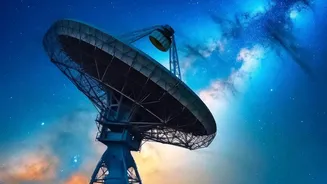
Located in British Columbia, Canada, the Canadian Hydrogen Intensity Mapping Experiment (CHIME) doesn't look like a traditional telescope. Instead of a giant dish, it consists of four massive, 100-metre-long metal half-pipes. With no moving parts, it scans
over half the sky every single day as the Earth rotates. CHIME was designed to do two things very well: detect mysterious Fast Radio Bursts (FRBs) from deep space and create a massive 3D map of the universe to study dark energy. It’s this second goal where the telescope has just achieved a major milestone.
The Challenge: Mapping an Invisible Force
Since the late 1990s, astronomers have known that the universe's expansion is not slowing down, but speeding up. The unknown force driving this acceleration was named 'dark energy'. Understanding its nature—whether it's a constant force or something that changes over time—is a top priority. To do this, scientists need to measure the expansion history of the universe with incredible precision. This is usually done by painstakingly mapping the locations of millions of individual galaxies, a slow and expensive process. CHIME was built to try a different, more efficient method.
A New Cosmic Map-Making Technique
Instead of looking for the light of individual stars and galaxies, CHIME listens for the faint, low-frequency radio waves emitted by neutral hydrogen gas, the most abundant element in the cosmos. This technique is called 'hydrogen intensity mapping'. Think of it like seeing the overall shape of a forest from a distance, rather than plotting the position of every single tree. By measuring the combined glow of hydrogen from vast cosmic distances, CHIME can map the large-scale structure of the universe much faster and over a larger volume than any survey before it.
What Did CHIME Actually Demonstrate?
The major breakthrough is one of proof. For the first time, the CHIME collaboration has demonstrated it can detect the faint, large-scale clustering of hydrogen gas using only its own data. This is a huge deal. Previously, to be sure they were seeing a real cosmic signal, scientists had to cross-reference CHIME's data with galaxy maps from other telescopes. By successfully making a detection using 'auto-correlation'—analysing patterns within its own dataset—CHIME has proven that its novel mapping technique works on its own. This makes the process faster, cheaper, and more powerful, opening a new, independent window into the early universe.
A Glimpse of the Universe at Middle Age
The signal CHIME detected comes from a time when the universe was about five billion years old—a crucial period when dark energy's influence became dominant. The observations successfully measured faint imprints left over from the early universe known as Baryon Acoustic Oscillations (BAOs). These ripples in the distribution of matter have a standard size, acting like a giant cosmic ruler that astronomers can use to measure the expansion of space over time. While this initial result doesn't solve the dark energy mystery, it validates CHIME's ability to use this cosmic ruler at a previously difficult-to-study epoch.