



Seeing Back to the Cosmic Dawn
When we talk about the "early universe," we're referring to the first few hundred million years after the Big Bang. This period, known as the cosmic dawn, is when the very first stars and galaxies began to form, ending the cosmic dark ages. Understanding
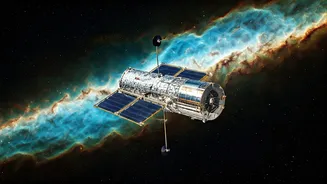
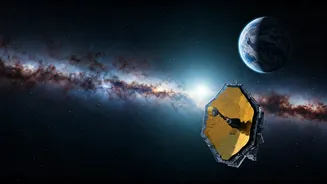
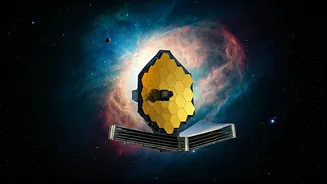
this era is crucial because it holds the secrets to how everything we see today, including our own Milky Way galaxy, came into being. The main tool driving these new discoveries is the James Webb Space Telescope (JWST). Because light takes time to travel, looking at extremely distant objects is like looking back in time. JWST's powerful infrared eyes can see the faint light from galaxies that existed over 13 billion years ago, giving us a direct window into this mysterious epoch of cosmic history.
Finding Galaxies That Grew Up Too Fast
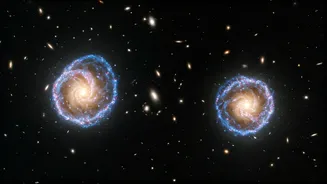
One of the biggest surprises from JWST is the discovery of galaxies that are far more massive and mature than our theories predicted. According to existing models, the first galaxies should have been small, messy, and chaotic, gradually merging and growing over billions of years. However, Webb has spotted multiple galaxies in the early universe that already look surprisingly well-formed and large. It’s like looking at a photograph of a baby and finding it has the body of a teenager. These findings have challenged the standard model of galaxy formation, which says the process should be slow and steady. Scientists are now exploring new theories, including the idea that early star formation could have happened in intense, rapid bursts, creating "superheated star factories" that accelerated galaxy growth.
The Mystery of Impossible Black Holes
Another major puzzle involves supermassive black holes. These cosmic giants, millions or even billions of times the mass of our sun, are found at the center of most large galaxies, including ours. The mystery is that JWST is finding them in the very early universe. According to our previous understanding, it should take a very long time for a black hole to grow to such an immense size, likely longer than the universe had been in existence at that point. The discovery of these 'overmassive' black holes suggests they either grew much faster than thought, perhaps by gobbling up gas at incredible rates, or they were born from much larger 'seeds' than previously imagined. Some theories propose that massive clouds of gas could have collapsed directly into a large black hole, skipping the star-formation step entirely.
What Are the 'Little Red Dots'?
Adding to the intrigue is the discovery of hundreds of mysterious objects that astronomers have nicknamed "Little Red Dots." First spotted in 2022, these compact, reddish objects are abundant in the early universe but don't fit neatly into any known category. While some might be very dusty, compact galaxies, detailed analysis of their light suggests many could be rapidly growing supermassive black holes cocooned in thick gas and dust. If this is true, these dots could represent a crucial, previously unseen phase of black hole evolution, offering a potential solution to how they got so big, so fast. Scientists are still debating whether these are a new type of cosmic object entirely.
Why This Changes Everything
These discoveries are more than just cosmic curiosities; they represent a fundamental shift in our understanding of the universe's evolution. The presence of unexpectedly large galaxies and black holes forces scientists to go back to the drawing board. Every new, puzzling observation is a clue that our current theories are incomplete. This is the scientific process in action: new data challenges old ideas, leading to revised models that better describe reality. These findings from the early universe are not just breaking records; they are breaking and rebuilding our most basic theories about how cosmic structures form and grow.