


Earth's Terrifying Twin
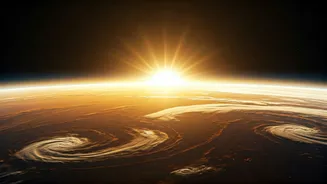
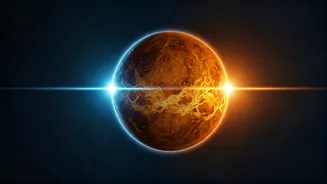
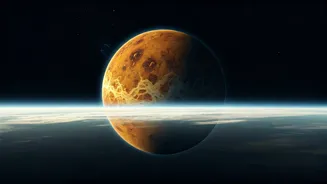
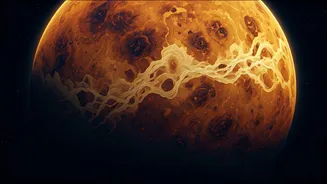
Venus is often called Earth’s twin, and for good reason. The two planets are nearly identical in size, mass, and composition. Yet, their paths diverged dramatically. While Earth became a haven for life, Venus devolved into a hellscape. Its atmosphere
is a thick, choking blanket of carbon dioxide, creating a crushing pressure 90 times that of Earth’s surface. Temperatures soar to over 450°C, hot enough to melt lead, and it rains sulfuric acid. Scientists believe Venus wasn't always this way; it likely once had oceans and a climate similar to Earth's before a runaway greenhouse effect took hold. Understanding how and why our planetary twin suffered this catastrophic climate shift is one of the most pressing questions in planetary science.
The Ultimate Climate Laboratory
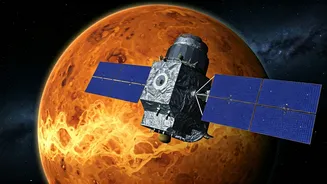
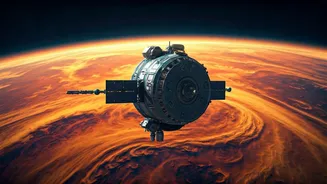
The most critical lesson Venus can teach us is about our own planet’s future. Studying Venus provides a natural, large-scale laboratory for understanding the ultimate consequences of a greenhouse effect. The Shukrayaan-1 mission aims to meticulously study the Venusian atmosphere, its composition, and its super-rotating cloud dynamics. By analyzing the processes that transformed Venus into an uninhabitable furnace, scientists can refine our climate models for Earth. This isn't just academic; it provides vital data to help us understand the tipping points in our own climate system, offering a stark warning from space about the long-term dangers of unchecked atmospheric changes. The mission seeks to understand not just another world, but the potential fate of our own.
A New Frontier for India
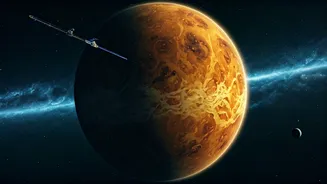
For the Indian Space Research Organisation (ISRO), Shukrayaan-1 represents the next logical frontier. Having successfully reached the Moon with Chandrayaan and Mars with the Mangalyaan mission, tackling Venus is a significant step up in complexity and ambition. The extreme environment demands more robust technology, from advanced sensors to spacecraft components that can withstand intense heat and radiation. The mission’s primary scientific payload will be a high-resolution Synthetic Aperture Radar (SAR), designed to peer through the planet’s dense clouds and map its surface geology in unprecedented detail. Successfully executing such a mission will not only yield immense scientific returns but also cement ISRO's reputation as a world-class agency capable of complex deep-space exploration.
The Global Race to Venus
India is not turning its attention to Venus in a vacuum. After decades of being overlooked in favour of Mars, our sister planet is the focus of a renewed international space race. NASA is gearing up for its DAVINCI and VERITAS missions, scheduled for the late 2020s and early 2030s. The European Space Agency (ESA) is also planning its EnVision orbiter for 2031. With Shukrayaan-1 approved for a 2028 launch, India is positioned to be a key player in this new wave of exploration. This strategic timing allows for potential collaboration and ensures India contributes significantly to the global understanding of Venus, reinforcing its status as a major spacefaring nation alongside the US, Europe, and China.
Driving Technology and a Space Economy
Beyond the scientific prestige, a mission like Shukrayaan-1 is a powerful engine for technological and economic growth. The challenges of interplanetary travel spur innovation in robotics, materials science, communication, and automation. These advancements often lead to commercial spin-offs and applications on Earth. Furthermore, the mission aligns with the Indian Space Policy's goal of fostering a robust private space ecosystem. By taking the lead on complex scientific missions, ISRO creates opportunities for private industry to participate in building components, developing software, and managing ground systems, thereby boosting India’s share in the global space economy and inspiring a new generation of scientists and engineers.