


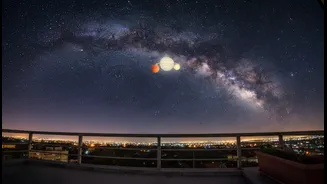


The Cosmic Highway Above
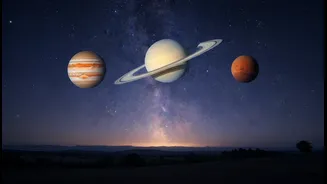
The secret to the arc of planets lies in a concept called the ecliptic plane. Imagine the solar system as a giant, flat disc, like a vinyl record with the Sun at the centre. All the planets, including Earth, orbit the Sun on roughly this same flat surface.
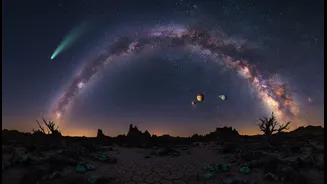
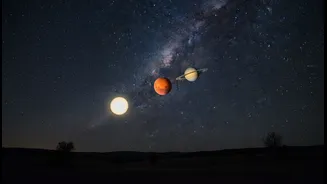
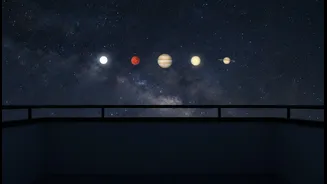
From our viewpoint on Earth, as we look out into space, we are seeing this disc edge-on. This line of sight creates an imaginary path across our sky that all planets, the Moon, and the Sun appear to follow. Astronomers call this path the ecliptic, and it acts like a grand cosmic highway upon which celestial bodies travel.
Why a Straight Path Looks Curved
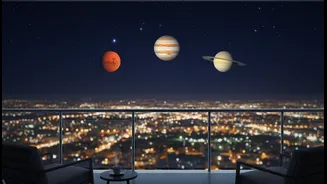
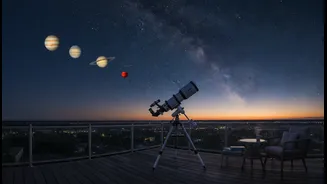
If the planets all travel on a flat plane, why do we see a curve? The answer is our own perspective. Earth is tilted on its axis by about 23.5 degrees relative to the ecliptic plane—this tilt is what gives us our seasons. Because we are standing on a tilted, spherical planet, our view of this flat highway in space gets projected across our domed sky as a magnificent arc. The arc's exact position changes depending on your location and the time of year, but the planets will always be found scattered along this celestial roadway.
July's Special Planetary Line-Up
This July, the celestial highway is particularly busy, offering a fantastic show for observers in India. In the evenings, just after sunset, brilliant Venus can be seen in the western sky. On July 17, it will be joined by a slender crescent Moon, creating a stunning and easy-to-spot pairing. For early risers, the pre-dawn sky is even more crowded. Throughout the month, Saturn is visible for several hours before sunrise. On July 7 and 8, the Moon paid Saturn a close visit. A few days later, on July 11, the crescent Moon will form a picturesque triangle with reddish Mars and the Pleiades star cluster.
More Than Just Planets
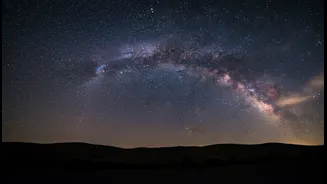
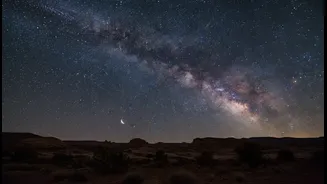
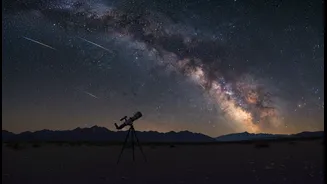
The reliable path of the ecliptic not only guides planets but also serves as a backdrop for other celestial events. Around the new Moon on July 14, the skies will be at their darkest, providing the best opportunity this year to see the faint, glowing band of our own Milky Way galaxy arching across the sky. Later in the month, the Southern Delta Aquariid and Alpha Capricornid meteor showers will peak around July 30-31. Though a bright Moon will interfere, the Alpha Capricornids are known for producing spectacular, bright fireballs that can light up the night.
How to See the Arc from India
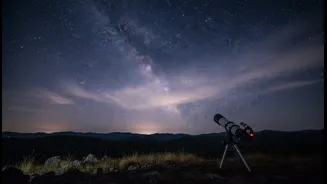
To best experience this celestial geometry, you don't need expensive equipment. The key is finding a location away from city lights, which can wash out all but the brightest objects. A rural area, a hilltop, or an open field will offer a much darker canvas. For evening events, like viewing Venus, find a spot with a clear western horizon. For the morning planetary gatherings with Mars and Saturn, you'll need an unobstructed view to the east. Give your eyes about 20-30 minutes to fully adapt to the darkness. Then, simply look up and trace the imaginary line connecting these planetary visitors to see the beautiful arc of our solar system for yourself.