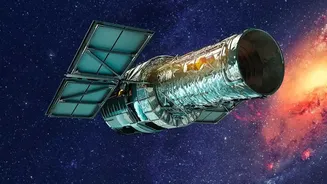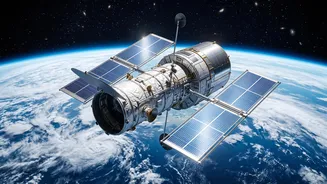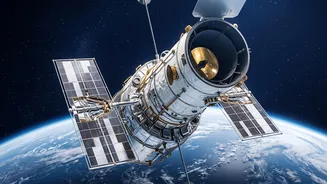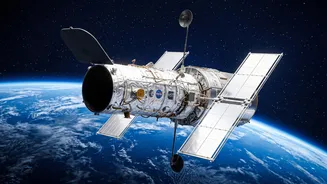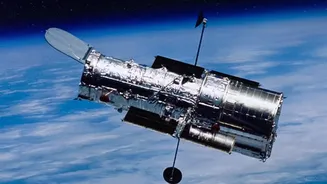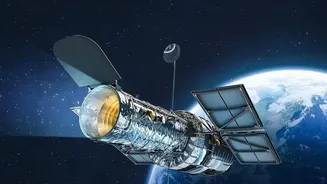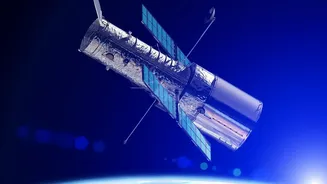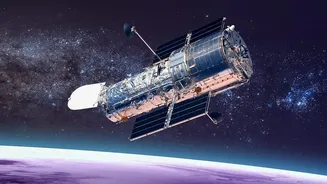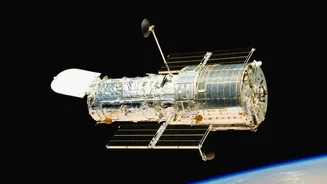




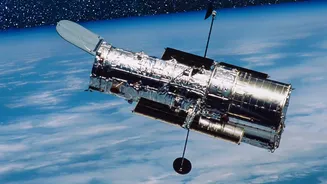
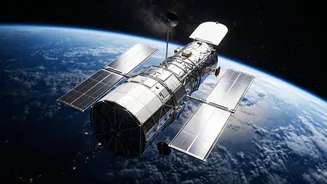
For over three decades, the Hubble Space Telescope has been humanity's tireless eye on the cosmos. But a silent threat looms: without its own engine, the legendary observatory is slowly falling back to Earth. Can it be saved?
A Slow but Accelerating Descent
Like any object in low-Earth
orbit, the Hubble Space Telescope is subject to atmospheric drag. Even at its altitude, hundreds of kilometers up, there are enough air molecules to act as a gentle brake on the school-bus-sized observatory. For years, this orbital decay was a slow, predictable process. However, recent solar activity has been stronger than forecasted. This energizes and expands Earth's upper atmosphere, increasing drag on Hubble and accelerating its descent. Currently, the telescope is losing altitude at a rate of about 14 kilometers per year, and projections suggest it could make an uncontrolled reentry into the atmosphere sometime between 2033 and 2034 if no action is taken. This timeline puts a clear deadline on any potential rescue effort.
Why the Old Fix Won't Work
Hubble was famously designed to be serviced in space. Five separate Space Shuttle missions flew to the observatory between 1993 and 2009. Astronauts performed spacewalks to repair systems, install new instruments, and, crucially, reboost its orbit. The final servicing mission in 2009 left Hubble at a higher altitude, extending its life significantly. However, with the retirement of the Space Shuttle fleet in 2011, NASA lost its only method for visiting the telescope. Since then, Hubble has been on its own, its fate dictated entirely by gravity and the faint drag of the atmosphere. While NASA attached a 'Soft Capture Mechanism' during that last visit, it was designed to help a future robotic mission safely de-orbit the telescope, not necessarily to service it again.
A New Era of Commercial Lifelines
The end of the Shuttle era coincided with the rise of a vibrant commercial space industry. In late October 2026, NASA officially issued a Request for Information (RFI), asking private companies for ideas on how to save Hubble. The request lays out three possibilities: boost Hubble to a higher orbit of at least 600 kilometers, service it to enhance its capabilities, or perform a safe, controlled de-orbit. This formal request follows a 2022 study conducted with SpaceX and the Polaris Program, a private human spaceflight initiative funded by billionaire Jared Isaacman, which found that a mission using a SpaceX Dragon capsule was technically feasible. Though NASA initially passed on that specific proposal, the new RFI reopens the door for a privately funded or executed mission to become a reality, with a response deadline of November 30, 2026.
The High-Stakes Technical Challenge
Saving Hubble is not a simple task. The telescope was never designed to be docked with by an automated, modern spacecraft like a Dragon capsule or a robotic tug. It lacks the guidance targets and docking ports that make linking up with the International Space Station a routine procedure. Any approaching vehicle would need to perform extremely precise proximity operations, grabbing onto the 11,000-kilogram observatory without its thruster plumes contaminating Hubble's sensitive optics or its fragile solar arrays being damaged. This delicate dance must be performed on an aging satellite that is also operating on a limited number of its stabilizing gyroscopes. The recent failure of a commercial mission to rescue the smaller Neil Gehrels Swift Observatory serves as a stark reminder of the risks involved in robotic servicing.