


The Cosmic Middle Child
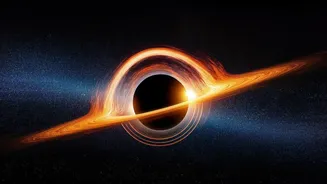
In the universe's family of black holes, we are well acquainted with two main types. First are the stellar-mass black holes, typically 5 to 100 times the mass of our sun, which are the corpses of giant, collapsed stars. At the other extreme are the supermassive
black holes, behemoths that weigh millions or even billions of times more than the sun and anchor the centers of most large galaxies, including our own Milky Way. For decades, a significant gap existed between these two classes. Scientists wondered: where were the black holes in the middle? This long-sought "missing link" is known as an intermediate-mass black hole, or IMBH, with a mass ranging from 100 to 100,000 times that of the sun. Their existence is a critical piece of the puzzle, as they are believed to be the seeds from which supermassive black holes grow.
A Violent Dance of Mergers
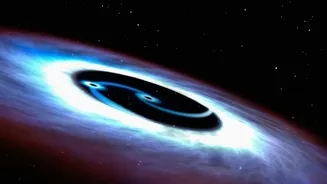
IMBHs are too big to be formed from a single star's collapse. Instead, leading theories suggest they are born in dense environments like globular clusters or the hearts of dwarf galaxies through two primary pathways: runaway collisions of massive stars or the hierarchical merging of smaller black holes. When two of these IMBHs, or an IMBH and a smaller black hole, are caught in a gravitational embrace, they perform a cosmic dance, spiraling closer together over millions of years. This process culminates in a cataclysmic merger that sends powerful ripples through the fabric of spacetime itself. These ripples are gravitational waves, and their detection by observatories like LIGO and Virgo has opened a new window into these violent events, providing the first direct evidence of IMBH mergers. A 2023 detection, for instance, confirmed a merger between black holes of 85 and 65 solar masses, resulting in a new IMBH of 142 solar masses.
The Kick that Reshapes a Galaxy
The merger of two black holes isn't a perfectly symmetrical event. The enormous energy released in the form of gravitational waves is often asymmetric, creating a powerful "kick" that propels the newly formed, more massive black hole in a single direction. This gravitational recoil can be powerful enough to move the black hole at tremendous speeds. This is where the connection to galactic mass distribution becomes clear. A recoiling IMBH acts like a cosmic cannonball tearing through its host galaxy or star cluster. It can disrupt the orbits of stars, ejecting them from the cluster entirely. It can plow through vast clouds of interstellar gas, compressing them and triggering furious bursts of new star formation in its wake. In some cases, the kick can be strong enough to eject the IMBH from its home galaxy altogether, leaving it to wander through intergalactic space.
Connecting Theory to Observation
For years, these ideas were largely the domain of complex computer simulations, which modeled how galaxies and black holes co-evolve. These simulations showed that mergers were more frequent in the early universe and were a key mechanism for growing bigger black holes. Now, observational data is catching up. Recent analysis of gravitational wave events has identified several mergers that likely resulted in IMBH remnants. A team from the Xinjiang Astronomical Observatory recently identified a fading radio jet powered by an IMBH in a dwarf galaxy merger, suggesting the merger triggered the black hole's activity. By studying the motions of stars in dense clusters, astronomers can also infer the presence of a central IMBH. In the Omega Centauri cluster, the unusual speed of seven stars points to the gravitational influence of a black hole estimated to be at least 8,200 solar masses. Each observation provides another data point, helping to confirm that IMBH mergers are not just a theoretical possibility but a fundamental process shaping the cosmos.