


Catching a Planet's Shadow
It all starts with a simple, yet elegant, cosmic alignment known as a 'transit'. This is when an exoplanet, a planet outside our solar system, passes directly in front of its host star from our point of view. This transit causes a tiny, almost imperceptible
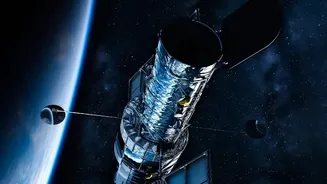
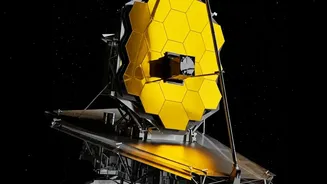
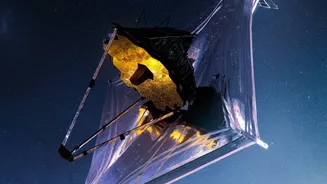
dip in the star's brightness. For decades, this has been the primary method for detecting exoplanets. The James Webb Space Telescope (JWST), however, takes this observation to a whole new level. It doesn't just note the dimming; it uses that moment to perform a deep atmospheric investigation.
Starlight Filtered Through an Alien Sky
As the planet transits, a small fraction of the starlight filters through the very edge of the planet's atmosphere. This is the magic moment JWST is waiting for. Using its incredibly sensitive spectrographs—instruments that spread light out into its component colors like a prism—the telescope captures this filtered light. Different gases in the planet's atmosphere will absorb very specific wavelengths, or colors, of this starlight. Each molecule, whether it's water vapor, methane, or carbon dioxide, leaves a unique chemical 'fingerprint' on the light that passes through. This technique is called transmission spectroscopy.
Reading the Chemical Barcode
After capturing the light, JWST's instruments, like the Near-Infrared Spectrograph (NIRSpec), break it down into a detailed spectrum. This spectrum looks like a graph with dips and peaks. The dips represent the specific wavelengths of light that were absorbed by the planet's atmosphere. By analyzing the position and depth of these absorption lines, scientists can create a 'barcode' that tells them exactly which chemicals are present in that distant world's air. This is how Webb made the first-ever detection of carbon dioxide and sulfur dioxide in a gas giant's atmosphere, providing evidence of chemical reactions driven by starlight.
Seeing a Planet's Own Glow
JWST has another trick up its sleeve. It doesn't just analyze starlight passing through an atmosphere; it can also measure the light coming from the planet itself. Using a method called secondary eclipse photometry, the telescope watches as the planet disappears behind its star. Just before it vanishes, Webb measures the total infrared light from both the star and the planet. When the planet is hidden, it measures the light from the star alone. By subtracting one from the other, astronomers can isolate the faint infrared glow emitted by the planet's hot dayside. This thermal emission tells them the planet's temperature and can offer clues about its surface conditions—whether it's a bare rock or something more complex.
From Data to Daring Discoveries
These techniques are already revolutionizing our understanding of rocky exoplanets. For example, observations of the super-Earth 55 Cancri e, a blisteringly hot 'lava world', suggest it may have a substantial atmosphere, which challenges previous theories about how atmospheres can survive so close to a star. Conversely, studies of TRAPPIST-1 b, a planet once thought to be a candidate for habitability, indicate it has little to no significant atmosphere based on its high dayside temperature. These findings, made possible by JWST's unprecedented sensitivity to infrared light, show that the universe of rocky planets is far more diverse and complex than we ever imagined.