



The Sun’s Unpredictable Temper
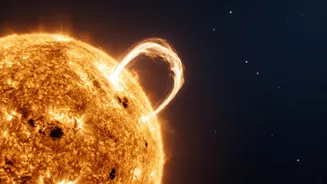
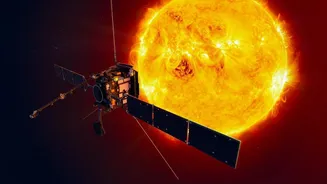
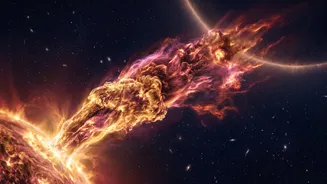
Space weather refers to the dynamic conditions in space driven by the Sun. Our star is constantly emitting a stream of charged particles known as the solar wind. Occasionally, however, it unleashes much more violent events. Solar flares, which are intense
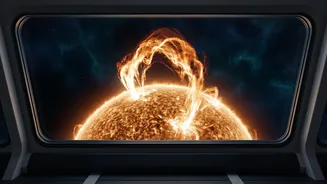
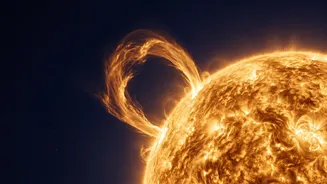
bursts of radiation, and coronal mass ejections (CMEs), which are massive eruptions of plasma and magnetic fields, send huge amounts of energy hurtling through the solar system. While Earth’s magnetic field protects us from the worst of it, a sufficiently strong and Earth-directed event can have serious consequences for our modern way of life. These events are a natural part of the Sun's 11-year cycle of activity, but their timing and intensity can be dangerously unpredictable.
A Threat to Our Digital World
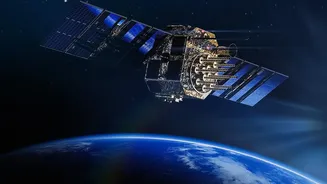
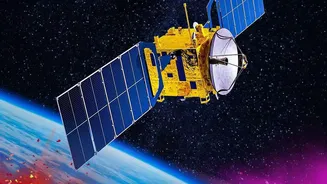
Our increasing reliance on technology makes us more vulnerable to space weather than ever before. A powerful geomagnetic storm, caused by a CME interacting with Earth's magnetic field, can induce powerful currents in the ground. These currents can flow into and overload high-voltage transformers, potentially causing widespread and long-lasting power outages, as seen in Quebec in 1989. Beyond the grid, this solar radiation can damage the sensitive electronics on satellites, disrupting everything from GPS navigation and telecommunications to weather forecasting. In a worst-case scenario, this could affect aviation, road transport, global financial systems, and emergency services that depend on precise positioning and communication.
The Old Way Was Too Slow
Traditionally, forecasting space weather has been a reactive process. Scientists use satellites to observe the Sun, and when a CME is detected, they model its trajectory to see if it will hit Earth. The problem is that these ejections travel incredibly fast, sometimes reaching our planet in less than a day, while the radiation from a solar flare arrives in just eight minutes. This leaves very little time for authorities and infrastructure operators to take protective measures. Previous prediction models that didn't use AI could provide global forecasts, but they weren't timely enough to be truly effective in a fast-moving crisis. Other AI-based models could only provide localized forecasts for specific areas. A better, faster system was needed.
Enter DAGGER: AI's Predictive Power
To solve this problem, NASA has supported the development of an advanced computer model called DAGGER (Deep Learning Geomagnetic Perturbation). This system combines artificial intelligence with real-time data from a fleet of NASA satellites that monitor the solar wind. By training the AI on vast amounts of historical data, researchers have taught it to spot the subtle relationships between solar wind measurements and the resulting geomagnetic disturbances on Earth. The result is a system that can predict where a solar storm will strike anywhere on the globe with a crucial 30-minute advance warning. According to researchers, the model can generate a worldwide prediction in less than a second and updates it every minute.
Why 30 Minutes Is a Game-Changer
While 30 minutes might not sound like much, in the context of protecting critical infrastructure, it’s a revolutionary leap forward. This warning period gives power grid operators enough time to take sensitive systems offline to prevent catastrophic damage to transformers. Satellite controllers can reorient their spacecraft or place them into a safe mode to protect delicate electronics. Airlines can reroute flights that would otherwise pass over the poles, where the effects of solar radiation and radio blackouts are most severe. The open-source nature of the DAGGER model means that companies and agencies can adapt it to their specific needs, creating tailored alerts to safeguard their assets. It transforms the response from damage control to proactive prevention.