


The Classic Stellar Forge
For decades, the prevailing wisdom was that stars were the universe's primary chemical factories. These massive nuclear furnaces are where light elements are fused into heavier ones, like the carbon that forms the backbone of all known life. The intense
heat and energy of stellar environments, including the explosive deaths of stars in supernovae, were seen as the primary drivers for creating and distributing the elemental ingredients necessary for chemistry across the cosmos. This stellar-centric view suggested that the areas immediately surrounding stars and the remnants they left behind were the most promising places to look for the genesis of organic complexity.
A Shift into the Cold
Recent discoveries, many powered by the unprecedented capabilities of the James Webb Space Telescope (JWST), have prompted a major shift in focus. Astronomers are finding that some of the most interesting organic chemistry isn't happening in the blazing heat of stars, but in the most frigid, desolate places imaginable: deep interstellar space and dense molecular clouds. These regions, with temperatures hovering just a few degrees above absolute zero, were once thought to be chemically inert. However, it turns out these icy dust grains act as tiny cosmic laboratories, providing surfaces where atoms and simple molecules can meet, interact, and build into more complex structures.
An Inventory of Cosmic Ingredients
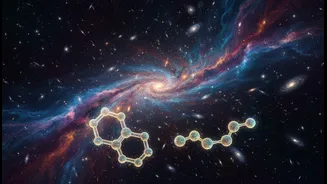
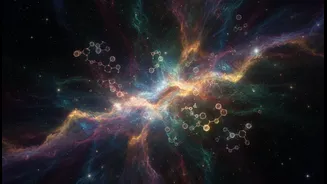
The findings have been astonishing. Scientists have detected an unexpected richness of complex organic molecules (COMs) in these cold environments. The list includes alcohols like ethanol, compounds like acetic acid (the main component of vinegar), and even simple sugars. JWST has identified a plethora of organic molecules within the dense, dusty nucleus of a galaxy outside our own, including methane and benzene. These aren't signs of life itself, but they are the crucial prebiotic molecules—the raw ingredients that, under the right conditions, could combine to form amino acids and nucleotides, the very foundation of proteins and DNA. The detection of molecules like the methyl cation (CH3+) further confirms that interstellar space is a hotbed for the formation of more complex carbon-based molecules.
From Interstellar Clouds to Earth
This new understanding of cosmic chemistry helps solve a long-standing puzzle: how did early Earth get its supply of organic materials? While some could have formed in Earth's primordial atmosphere, the sheer abundance of these molecules in space offers another compelling pathway. Meteorites, which are fragments of asteroids and comets, have been found to contain a variety of organic compounds, including the building blocks of DNA and RNA. This provides tangible evidence that these materials, forged in the cold depths of interstellar space billions of years ago, can be delivered directly to planetary surfaces. It suggests that the primordial soup that may have given rise to life on Earth wasn't just homegrown; it was seasoned with ingredients from across the galaxy.