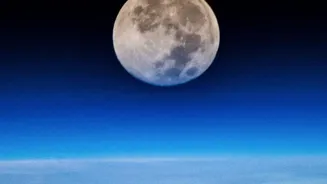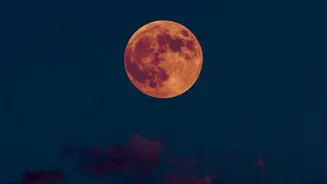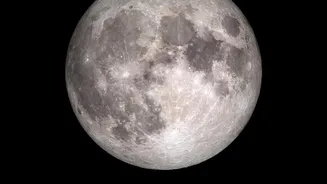




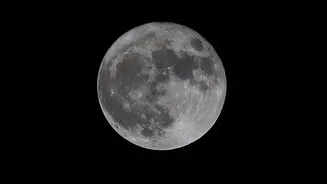
We’ve all seen it: a colossal, orange-tinted Moon hovering just above the horizon, looking large enough to touch. Hours later, it's a small, silvery disc high in the sky. But what if the giant Moon was just a trick of the mind?
An Illusion as Old as Time
The feeling that the Moon
is enormous when it's low in the sky is so common it has a name: the Moon illusion. This phenomenon has been documented for millennia, with thinkers as far back as Aristotle in the 4th century BCE noting the apparent change in size. For centuries, the leading theory was that the Earth's atmosphere acted like a magnifying glass, enlarging the Moon's image when it was near the horizon. However, modern science and simple photography have proven this is not the case. If you take a picture of the horizon Moon and another of the zenith Moon with the same camera settings, you’ll find they are the same size. The illusion is not happening in the sky, but inside our heads.
The Unchanging Moon on Your Retina
The core of the puzzle lies in a simple, counterintuitive fact: the image of the Moon projected onto your retinas is virtually the same size, whether it is high overhead or low on the horizon. In fact, from a purely physical standpoint, the Moon is slightly farther away from you when it's on the horizon than when it's at its zenith (the point directly overhead). When the Moon is overhead, you are looking straight out into space. When it's on the horizon, you're looking across the radius of the Earth, adding a distance of about 6,400 kilometres. This actually makes the horizon Moon about 1.5% smaller in its angular size. So, scientifically, the image cast on our eyes is actually a tiny bit smaller when it appears biggest to us. This proves the phenomenon is purely a perceptual illusion.
The Brain's Deception: Apparent Distance
The most widely accepted explanation for the Moon illusion is the 'apparent distance' theory. This theory suggests that our brain judges the size of an object based on its perceived distance. When the Moon is on the horizon, our line of sight includes terrestrial cues like trees, buildings, and mountains. Our brains know these objects are far away and uses them as reference points. Because the Moon is behind these distant objects, our brain assumes it must be incredibly far away. To compensate, our perceptual system scales it up, making it seem enormous. When the Moon is high in the sky, there are no intervening objects, just vast, empty space. With no cues for distance, our brain perceives the sky overhead as being closer than the sky at the horizon, and thus interprets the Moon as being smaller.
A Famous Trick: The Ponzo Illusion
The apparent distance theory is closely related to a classic optical trick called the Ponzo illusion. In the most common example of this illusion, two identical horizontal lines are placed between two converging vertical lines, like railway tracks stretching into the distance. The line that is closer to where the tracks converge (the 'farther' one) appears much larger than the other one. Our brain interprets the converging lines as a sign of distance and assumes the top line must be bigger to project an image of the same size from further away. The Moon illusion works similarly. The landscape stretching to the horizon provides the 'converging lines'. The Moon on the horizon is like the top line in the Ponzo illusion; our brain, tricked by the distance cues of the terrain, inflates its perceived size.
It’s Not Just About Trees
While the presence of objects on the horizon is a powerful part of the illusion, it might not be the whole story. Airline pilots flying at high altitudes, with no trees or buildings in their view, still report experiencing the Moon illusion. This has led to a complementary theory that our brains naturally perceive the sky as a flattened dome rather than a perfect hemisphere. We think of clouds and objects overhead as being physically closer than clouds on the distant horizon. So, when the Moon is on that 'distant' part of our flattened sky-dome (the horizon), our brain again assumes it's farther away and scales it up. This combination of environmental cues and our brain’s built-in assumptions about the world creates one of nature's most compelling and persistent optical illusions.