





Stretching across Rajasthan's arid landscape, Sambhar Lake is a shimmering expanse of salt and water. More than just India's largest inland saltwater lake, it is an ancient centre of commerce, a mythological landmark, and a critical ecological hub.
A Landscape Shaped by Salt
Located
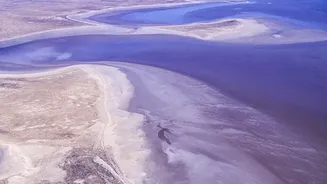
about 80 km southwest of Jaipur, Sambhar Lake is a vast, shallow wetland that expands and contracts with the seasons. During the monsoon, it can cover up to 230 square kilometres, fed by several seasonal rivers, but it shrinks dramatically in the dry heat, leaving behind glittering salt flats. This natural process of evaporation is what makes the lake hypersaline and creates the foundation for its most famous industry: salt production. For over a thousand years, people have harvested 'white gold' from these pans. A 5.1 km long stone dam, originally built during the colonial era, divides the lake basin, separating the natural western part from the eastern section, where a network of evaporation ponds and canals are used for commercial salt extraction.
An Ancient Hub of Commerce and Culture
The history of Sambhar is etched in salt. Evidence suggests salt may have been harvested here since the time of the Indus Valley Civilization. The lake's name itself is linked to Shakambhari, a form of the goddess Durga, who, according to legend, transformed a forest of precious jewels into a lake of salt to prevent greed and strife. Over centuries, control of this valuable resource was contested by Rajputs, Marathas, and Mughals, highlighting its economic importance long before the British leased it in 1870 and modernized production. Today, the enterprise is managed by Sambhar Salts Limited, a joint venture between the central and state governments, producing nearly 200,000 tonnes of salt annually.
A Paradise for Feathered Visitors
Beyond its economic role, Sambhar Lake is an ecological treasure. Designated a Ramsar Site—a wetland of international importance—in 1990, it is a crucial stopover for tens of thousands of migratory birds on the Central Asian Flyway. Between November and February, the lake transforms into a spectacular wildlife haven, most famously for the flocks of Greater and Lesser flamingos that arrive from as far as Siberia and Mongolia. These birds are drawn to the lake's unique ecosystem, feeding on the algae and brine shrimp that thrive in the saline water. In fact, the specialized microalgae are what give the salt crystals, and the flamingos themselves, their distinct pinkish hue.
An Ecosystem Under Pressure
Despite its significance, Sambhar Lake faces severe environmental threats that jeopardise its future. Uncontrolled and illegal groundwater extraction for private salt production has drastically lowered the water table. The encroachment of illegal salt pans has shrunk the natural habitat available for birds. This, combined with pollution and reduced water inflow from its feeder rivers due to dams, has degraded the wetland. These pressures have led to alarming events, including mass bird deaths in 2019 and 2024 attributed to avian botulism, a disease triggered by changing water conditions. Conservationists warn that without urgent intervention to regulate illegal activities and manage water resources sustainably, the lake's delicate ecological balance is at risk of collapsing.