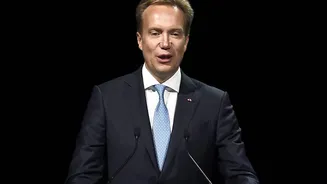







A 'Slow-Moving Tsunami'
When the head of the International Monetary Fund (IMF) speaks, the financial world listens. Recently, Managing Director Kristalina Georgieva has focused on a technology issue with profound economic consequences: artificial intelligence. She described
AI's impact as a 'slow-moving tsunami', highlighting its potential to disrupt labor markets, worsen inequality, and even threaten financial stability if left unmanaged. According to recent IMF analysis, AI is already contributing to economic growth, with private-sector investment expected to surge past $2 trillion globally in 2026. However, this boom comes with a stark warning: if the promised productivity gains don't materialize as quickly as hoped, the massive, often debt-financed, investments could lead to a sharp market correction and widespread job losses.
The Job Market at a Crossroads
A central concern in the IMF's assessment is the profound impact on employment. Their research suggests that nearly 40% of jobs globally are exposed to AI, with that number rising to 60% in advanced economies. The technology presents a dual threat: for some, it will augment their roles and boost productivity, potentially leading to higher wages. For others, AI could take over core tasks, leading to lower demand for human labor, reduced wages, and fewer hiring opportunities. Georgieva warned this could hollow out demand for workers who perform routine tasks, while creating more low-paying service jobs — a scenario she noted is 'not a story to celebrate'. The IMF's analysis predicts that without intervention, AI is likely to worsen overall income and wealth inequality.
Financial Stability on the Line
Beyond the labor market, the IMF has flagged serious risks to global financial stability. The massive capital flowing into the AI ecosystem — funding everything from semiconductors to data centers — has created a highly leveraged and interconnected market. The IMF warns that if AI firms disappoint on revenue or earnings, it could trigger a correction in equity prices that cascades through the system, spreading losses globally due to cross-border asset holdings. This 'wrong-way risk' is amplified by circular financing deals, where large tech companies invest in smaller AI firms in exchange for future revenue commitments. If those smaller firms face financial distress, the larger investors could see their equity and debt investments fall in value just as the expected revenue fails to appear.
A Call for 'Guardrails'
So, what does 'responsible oversight' look like? Georgieva has likened the rapid, unregulated development of AI to 'Formula One race cars careening around with no barriers to protect the audience'. She argues that if there are no safeguards, the risks may exceed the opportunities. The IMF's proposed solution is not heavy-handed government control, but a hybrid approach. This would involve industry self-regulation combined with government input, particularly from major AI players like the US, China, and India. The goal is to create 'common sense standards' that build public trust in the technology. For governments, this means establishing social safety nets and retraining programs for displaced workers, reinforcing governance frameworks for AI in finance, and even rethinking tax systems that traditionally rely on labor income — a revenue source AI could erode.