




Why Titan is an Irresistible Target
Of all the destinations in our solar system, Titan stands out as a tantalizing prospect for astrobiologists. It is the only moon with a dense atmosphere, primarily made of nitrogen like Earth's, and it hosts a weather system where liquid methane rains
down, carving rivers and filling lakes. Its surface is rich in complex organic molecules, the carbon-based compounds that are fundamental to life as we know it. Scientists believe Titan may harbour a chemical environment similar to that of early Earth, before life emerged. It possesses a subsurface ocean of liquid water, and there is evidence that this water may have mixed with surface organics in the past, creating a potential primordial soup. This makes Titan a unique natural laboratory for studying how far prebiotic chemistry can progress.
Meet Dragonfly: A Nuclear-Powered Octocopter
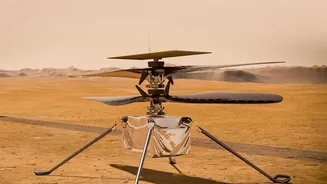
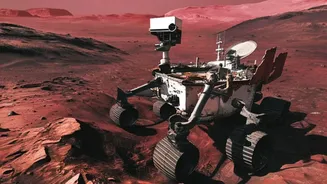
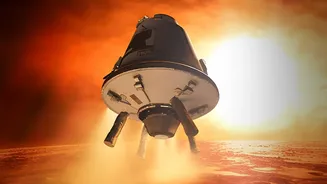
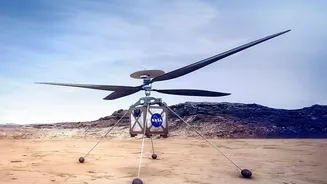
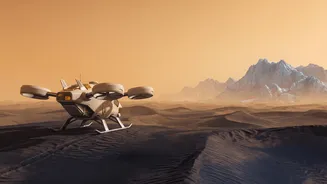
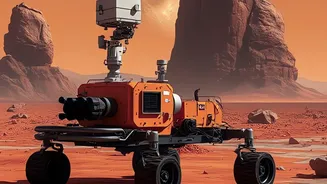
To explore this complex world, a simple rover won't do. NASA's solution is Dragonfly, a car-sized rotorcraft lander. Essentially a drone, Dragonfly is equipped with eight rotors, allowing it to take off, fly, and land vertically. This design is perfectly suited for Titan, where the atmosphere is four times denser than Earth's and gravity is significantly lower, making flight much easier than on Mars or Earth. Because solar power is not an option beneath Titan's thick, hazy skies, Dragonfly will be powered by a Multi-Mission Radioisotope Thermoelectric Generator (MMRTG), the same reliable nuclear power source used by the Curiosity rover on Mars. This gives it the energy needed for both flight and extensive scientific analysis.
The Flight Plan: A Leapfrogging Journey
Dragonfly's mission strategy is unlike any previous planetary mission. Instead of a single landing site or a slow crawl, it will perform a series of flights, or 'hops', to dozens of scientifically interesting locations across the moon's surface. The mission is scheduled to launch in July 2028 and arrive at Titan in 2034. Once there, during its planned multi-year primary mission, Dragonfly will travel farther than all Mars rovers combined. Each flight will last tens of minutes and cover several kilometres. The drone will spend most of its time on the ground, however—about one full Titan day (16 Earth days) at each site—to conduct its detailed scientific investigations and recharge its batteries using the MMRTG before its next leap. Its journey will take it from equatorial dune fields to the floor of an impact crater, Selk Crater, where evidence of past liquid water may be found.
A Suite of Sophisticated Instruments
Dragonfly is a flying laboratory carrying a powerful set of tools designed to answer its core questions. Its Dragonfly Mass Spectrometer (DraMS) will analyse the chemical composition of surface samples to identify organic compounds, including those relevant to life. To acquire these samples, the craft is equipped with a drill system called DrACO (Drill for Acquisition of Complex Organics), which can bore into the surface and transfer material to the mass spectrometer. The Dragonfly Gamma-Ray and Neutron Spectrometer (DraGNS) will measure the composition of the ground beneath the lander without contact, while the Dragonfly Geophysics and Meteorology package (DraGMet) will monitor weather conditions and search for 'Titanquakes'. Finally, its camera suite, DragonCam, will provide panoramic views and scout for future landing sites.