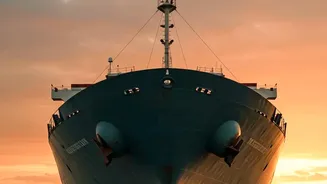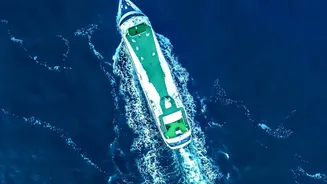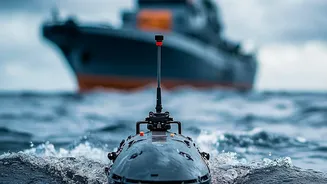



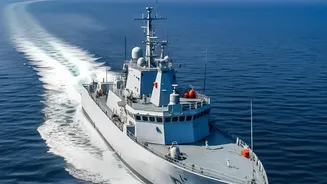
The idea of massive, self-driving cargo ships navigating the world’s oceans is no longer science fiction. But before these autonomous vessels can become a reality, they must be tested. Now, a breakthrough from IIT Madras is set to solve that.
A Digital Twin for the High Seas
Researchers
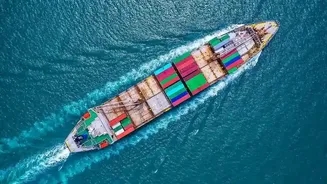
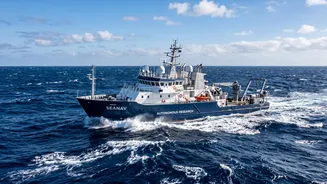
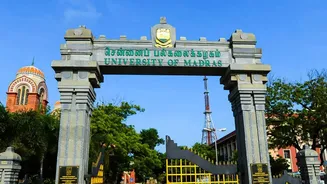
at the Indian Institute of Technology Madras have developed an innovative platform called 'SeaNav', a sophisticated simulator designed to drastically reduce the risks associated with testing autonomous ships. At its core, SeaNav is a 'digital twin'—a high-fidelity virtual replica of the maritime environment. Developed by the Department of Ocean Engineering, this platform allows engineers to test, validate, and train AI navigation systems in a realistic, computer-generated world before they are ever deployed on a physical vessel. This addresses a critical bottleneck in the development of autonomous maritime technology: the immense cost, complexity, and potential danger of real-world trials. The global shipping industry, which is responsible for carrying over 80% of world trade, stands to gain immense efficiencies from automation, but the journey to get there must be a safe one.
The Challenge of Real-World Testing
Testing an autonomous ship isn't like testing a self-driving car in a closed circuit. The open ocean is an unpredictable environment. A single software bug or sensor failure in a multi-thousand-tonne vessel could lead to catastrophic consequences, including collisions with other ships, running aground, causing environmental disasters like oil spills, and incurring massive financial losses. Furthermore, these autonomous systems need to be trained to handle countless scenarios, from navigating crowded ports and avoiding unexpected obstacles to operating in adverse weather conditions like heavy fog and rain. Conducting such extensive tests in the real world is not just hazardous but also prohibitively expensive and time-consuming. This is the problem SeaNav was built to solve, by providing a safe, controlled, and repeatable sandbox for these advanced algorithms.
How SeaNav Creates a Virtual Ocean
SeaNav provides a remarkably detailed simulation. Built on the Unity3D engine, it creates a virtual world that accurately replicates everything from ocean waves and vessel movements to complex port environments. The system integrates a sophisticated sensor fusion framework, combining data from simulated LiDAR, marine radar, and stereo vision cameras to mimic how a real ship perceives its surroundings. Crucially, unlike basic simulators, SeaNav also models realistic sensor limitations, such as electronic noise and data delays, forcing the AI to learn how to navigate in imperfect conditions. The simulator has been calibrated using a 320-meter benchmark tanker vessel, ensuring that the results from virtual tests closely mirror real-world performance. Researchers can even use virtual reality headsets to experience the simulation from the ship's bridge, offering a unique perspective for training and evaluation.
Pioneering Indian Maritime Technology
The development of SeaNav is a significant achievement for IIT Madras and India's broader ambitions in maritime technology. The project, led by researchers like Dr. Suresh Rajendran from the Department of Ocean Engineering, positions the institution at the forefront of autonomous systems. This work aligns perfectly with national initiatives like the 'Sagarmala Programme' and 'Maritime India Vision 2030', which promote the adoption of digital technologies and smart ports. The team at IIT Madras has a growing reputation in this field, with students from its 'Team Aritra' winning international competitions for autonomous boats. This culture of innovation is further supported by facilities like the National Technology Centre for Ports, Waterways and Coasts (NTCPWC) at IIT Madras, which focuses on creating indigenous maritime solutions. By developing this technology inhouse, India reduces its reliance on foreign systems and builds sovereign capability in a strategically critical sector.
The Future of Autonomous Shipping
The impact of SeaNav extends beyond just testing. Its multivessel simulation capabilities can be used for training human operators, developing strategies for coastal surveillance, and planning searchandrescue missions. Moreover, it can help design and validate AIassisted navigation systems for major Indian ports like Chennai, Mumbai, and Kochi, potentially reducing the risk of collisions and groundings in these busy waterways. As the maritime world inches closer to a future with varying degrees of autonomy, from decisionsupport systems to fully unmanned ships, the need for robust verification and validation tools will only grow. Innovations like SeaNav are not just academic exercises; they are crucial enablers for a new era of safer, more efficient, and smarter global shipping, with Indian engineering playing a pivotal role.