





Your Garment's Essential Guide
Think of a care label as a cheat sheet provided by the manufacturer. It offers crucial advice on how to wash, dry, and care for the fabric to maintain its quality, shape, and colour. Ignoring these instructions can lead to unfortunate laundry accidents.
Without proper guidance, colours can bleed, fabrics can shrink several sizes, and delicate materials can rip or lose their texture. Essentially, that little tag is the single best tool you have to protect your clothing investment and ensure your favourite items have a long and happy life in your wardrobe.
Decoding the Laundry Symbols
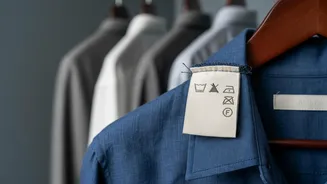
Care labels use a universal system of pictograms to bridge language barriers. While they might look like hieroglyphics at first, they're quite simple once you know the basics. The five main categories are washing (a tub of water), bleaching (a triangle), drying (a square), ironing (an iron), and professional care (a circle). For washing, dots inside the tub indicate the recommended water temperature—one dot for cold, two for warm, and three for hot. A line underneath the tub means to use a gentler cycle, like permanent press, while two lines signal a delicate cycle is needed. An 'X' through any symbol means 'do not do this.'
The 'Dry Clean Only' Warning
The 'Dry Clean Only' instruction is perhaps the most important one to follow. This label is used for garments made from materials like wool, silk, rayon, or those with structured linings and embellishments that can be permanently damaged by water. Machine washing or even hand washing these items can cause shrinking, stretching, loss of shape, and colour fading. The agitation of a washing machine can ruin delicate details like beading or embroidery, and water can damage the internal structure of tailored items like blazers. Dry cleaning uses chemical solvents instead of water, a much gentler process for these sensitive fabrics.
Understanding Your Fabrics
The instructions on a care label are directly tied to the fabric composition. Natural fibres like cotton are generally robust and can handle machine washing, while others require more specific care. Wool and cashmere, for example, can shrink or felt if washed in hot water or agitated too much in a machine. Silk is another delicate fabric that can lose its shape and lustre if not handled properly. Synthetic fabrics like polyester are often durable, but can be sensitive to high heat in the dryer or from an iron. The label takes the guesswork out of caring for these different materials, providing tailored instructions for each garment.
Smarter Ways to Handle Annoying Tags
If a tag is genuinely irritating, you don't have to choose between comfort and clothing care. Before you reach for the scissors, take a quick photo of the label with your phone. You can create a dedicated album for your garment care instructions, so the information is always handy. For a more organised approach, you could even create your own tagless system by using a fabric marker or iron-on transfer paper to put the essential symbols discreetly on the inside of the garment. Another simple solution is to cover the itchy label with a soft piece of iron-on hemming tape, which conceals it without destroying the information.