
Our Restless Cosmic Neighbourhood
Our solar system is filled with millions of asteroids and comets, collectively known as Near-Earth Objects (NEOs), that orbit the Sun. These are leftovers from the formation of our solar system billions of years ago. While most keep a safe distance, some
have orbits that bring them close to Earth. NASA defines a Potentially Hazardous Object (PHO) as an asteroid or comet that comes within 8 million kilometres of our planet's orbit and is large enough—typically over 30 to 50 metres—to cause significant damage if it were to impact. An object of this size could flatten millions of trees, as seen in the 1908 Tunguska event, while larger impacts, though rarer, could devastate entire regions. This is why finding these objects is a critical first step.
The Global Sentinel Network
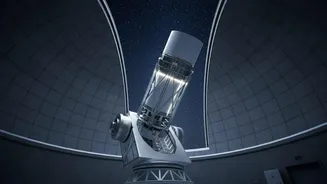
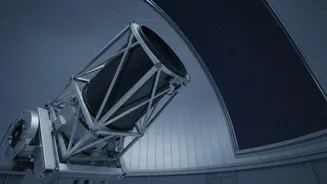
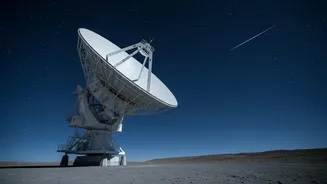
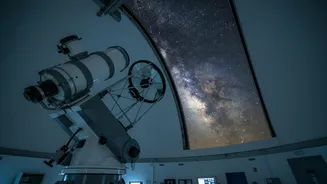
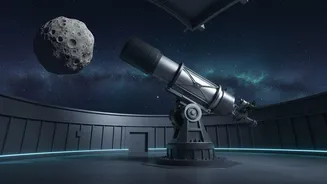
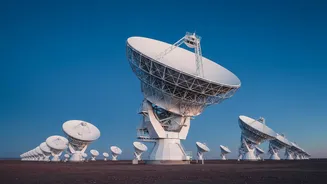
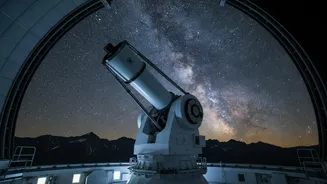
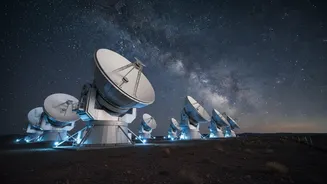
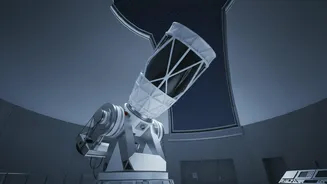
Planetary defense is not science fiction; it's a real and continuous global effort. Spearheaded by organisations like NASA's Planetary Defense Coordination Office (PDCO), established in 2016, a worldwide network of ground-based and space telescopes relentlessly scans the sky. Projects like the Catalina Sky Survey and Pan-STARRS, along with contributions from international partners like the European Space Agency (ESA), act as our planet's eyes on the cosmos. These surveys use powerful cameras to take pictures of the night sky, using software to detect faint points of light that move against the background of stationary stars. Each new detection is reported to the Minor Planet Center, a global clearinghouse for all NEO observations, to be catalogued.
Why Continuous Scanning is Key
The key to effective planetary defense is time. The earlier we can spot a potentially hazardous object, the more options we have. Continuous, uninterrupted scanning is crucial because these objects are often small, dark, and fast-moving. A new object might only be visible for a short period before it becomes too faint to see again. If follow-up observations aren't made quickly, an object can be 'lost'. Furthermore, ground-based telescopes are limited by weather, daylight, and can be blinded by the Sun's glare, which can hide asteroids approaching from that direction. By having a network of observatories around the globe, and by supplementing them with space-based telescopes, we ensure a 24/7 watch that can cover the entire sky.
From Detection to Alert
Once an object is discovered, the work is far from over. Astronomers around the world conduct follow-up observations to refine the object's trajectory. This data is fed into sophisticated systems like NASA's Sentry and Scout at the Center for Near-Earth Object Studies (CNEOS). These automated systems continuously calculate and recalculate orbits, projecting them up to 100 years into the future to check for any possibility of an Earth impact. If a credible threat is identified, a formal alert process begins. Through the International Asteroid Warning Network (IAWN), a UN-endorsed collaboration, findings are verified before notifications are sent to government bodies.
Future-Proofing Our Skies
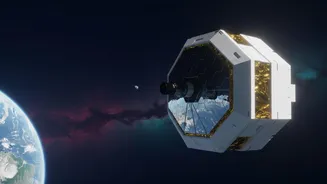
The work of planetary defense is constantly evolving. NASA's successful Double Asteroid Redirection Test (DART) mission in 2022 proved that we can change an asteroid's orbit by crashing a spacecraft into it—a technique known as a kinetic impactor. This was the first time humanity demonstrated a viable planetary defense technology. Looking ahead, missions like NASA's NEO Surveyor space telescope, scheduled to launch around 2027, will dramatically accelerate our ability to find hazardous objects. By using an infrared telescope, NEO Surveyor will be able to spot asteroids that are too dark or too hidden in the Sun's glare for ground telescopes to see, helping to complete the congressionally mandated goal of finding at least 90% of NEOs larger than 140 metres.